Allpowers R600 Portable Power Station Review
Six months, three severe storms, and countless nights in a freezing van. Is the budget-friendly Allpowers R600 a brilliant entry-level power station, or just an overpriced paperweight?
Picture this: It's half-past two in the morning. Outside, a miserable British deluge is hammering against your van's roof panels like a manic jazz drummer. Inside, the temperature is dropping faster than the pound after a bad budget, and your phone—your sole source of navigation, entertainment, and sanity—is sitting on a dead, blinking 1%.
You look at the cheap, unbranded leisure battery setup you cobbled together from a dodgy eBay listing, and it's completely flat. Absolute silence.
This is the gritty reality of trying to live on the road without proper power. It leaves you cold, disconnected, and staring into the darkness wondering why on earth you didn't just stay in a house with bricks and central heating.
Which brings us neatly to the unit sitting on my bench today: the Allpowers R600.
At roughly £190, it promises to solve your off-grid electrical woes without requiring you to remortgage your house or learn how to crimp heavy-duty copper lugs. But can a tiny, budget-friendly 299Wh box actually cut it when you're living the van life, or is it just a glorified paperweight? I've spent six months living with this thing, putting it through its paces in real-world conditions. No sponsorships. No fluff. Just the brutal truth.
The Specs: What Do You Actually Get?
Before we talk about whether it actually works, let’s look at what Allpowers has stuffed inside this plastic box. It weighs about 6 kg—light enough to toss into the passenger seat without a hernia, but substantial enough that it doesn't feel like a cheap toy you’d win at a fairground.
It uses a LiFePO4 (Lithium Iron Phosphate) battery. If you aren't an electrical nerd, all you need to know is that it won't explode if you look at it wrong, and it'll last for years before the capacity starts to degrade. It pushes out 600W of continuous power, with a 1200W surge capacity for when an appliance gets ambitious at startup.
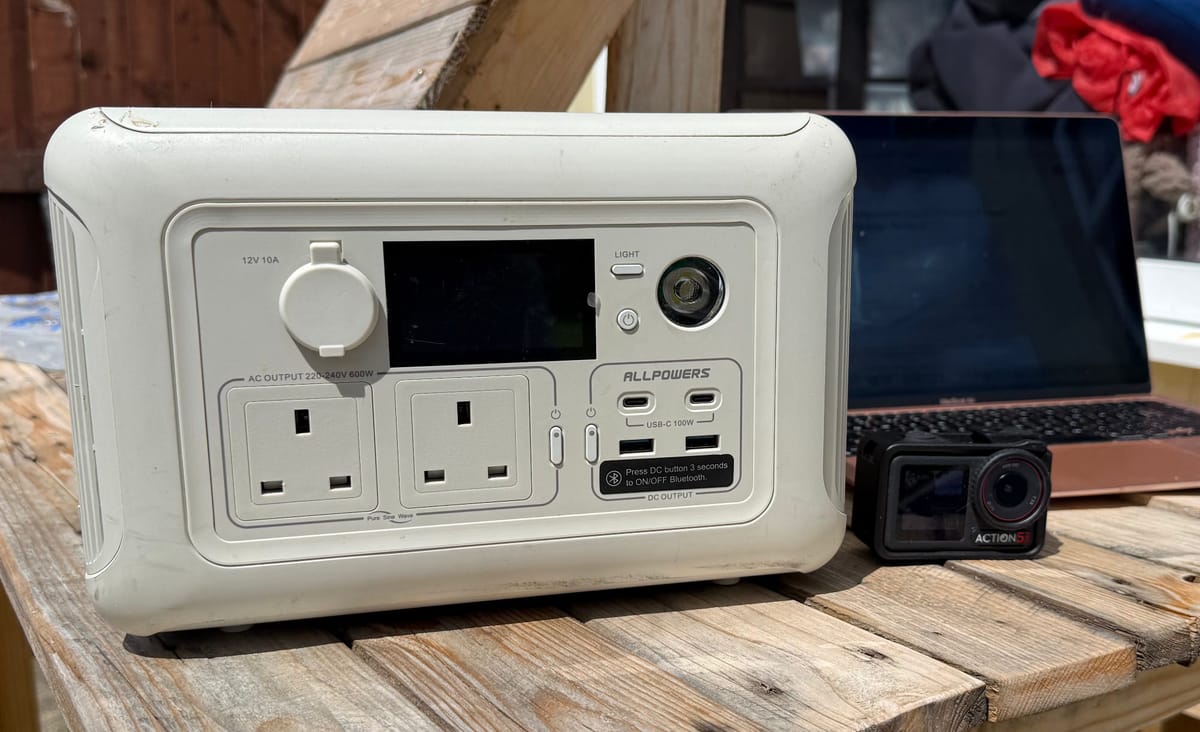
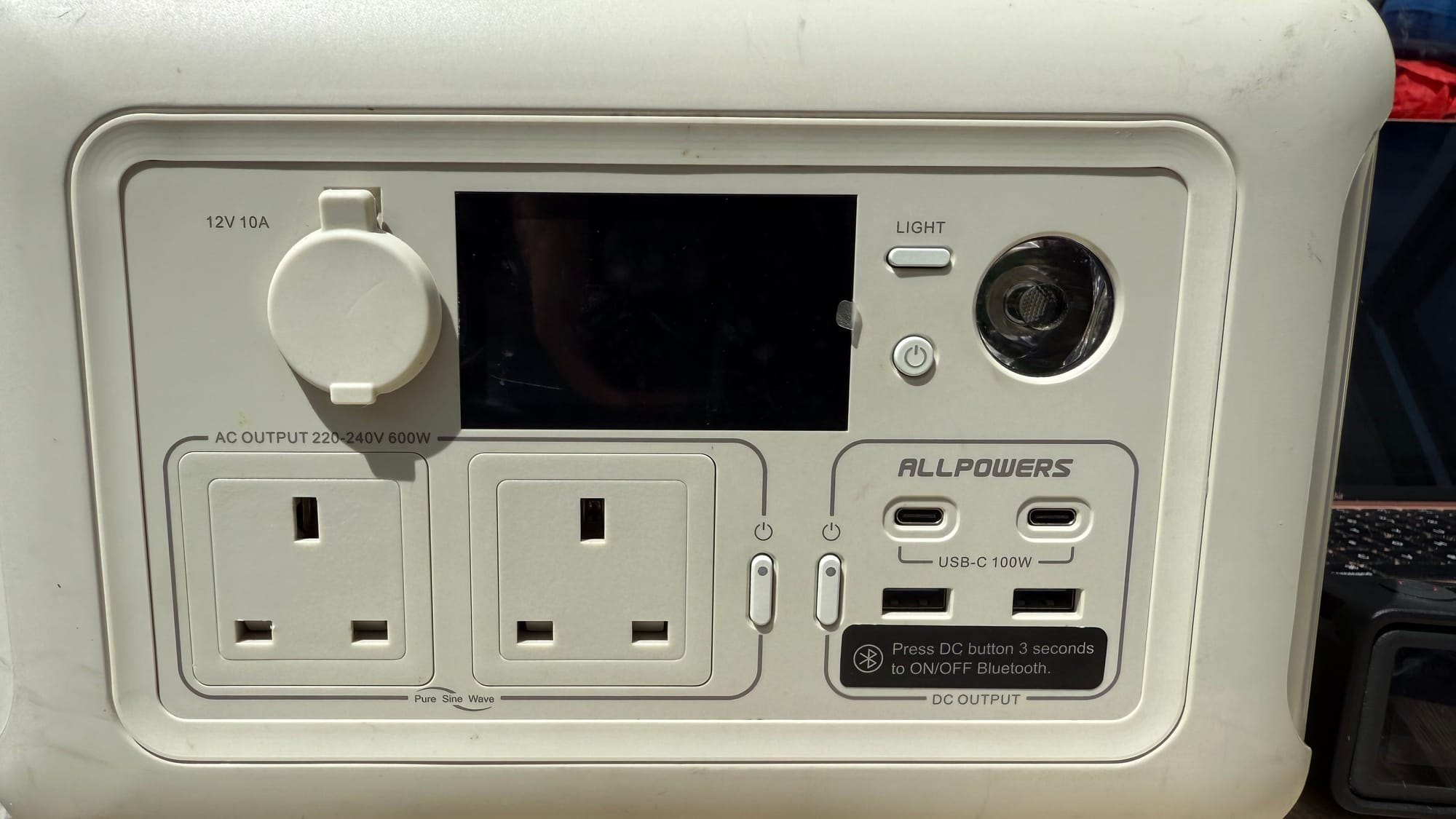
The port selection is remarkably generous for something this small. You get two proper AC outlets, a couple of USB-A ports, two hefty 100W USB-C ports, a 12V car socket, and—brilliantly—a 15W wireless charging pad slapped right on top.
For those who like to read the small print before parting with cash, here's the full spec sheet:
| Feature | Specification |
|---|---|
| Battery Capacity | 299Wh (25.6V, 11.68Ah) |
| Battery Type | LiFePO4 (Lithium Iron Phosphate) |
| Output Power | 600W (Surge 1200W) |
| Total Output (AC + DC) | 700W Max |
| AC Input | 100-120V, 4A Max / 220-240V, 2A Max |
| Solar Input | 12-60V, 12A Max, 300W Max |
| Car Charger Input | 12V/24V DC |
| AC Output | 2 x AC Outlets (100-120V / 220-240V, 600W Max) |
| USB-A Output | 2 x USB-A Ports (5V=3A, 9V=2A, 12V=1.5A, 36W Max) |
| USB-C Output | 2 x USB-C Ports (100W Max each, 200W Total) |
| DC Car Port Output | 1 x Car Socket (12V=10A, 120W Max) |
| Wireless Charger | 15W Max |
| Charging Modes (AC) | Fast Charge (400W), Standard (300W), Mute (200W) |
Real-World Capacity: The Math vs. The Mud
Allpowers' marketing department loves to talk about theoretical capacities. But out in the wild, when you're parked with a phone that just about to die on you, theory doesn't mean sod all.
If you are keeping your demands modest, the 299Wh capacity stretches surprisingly far. In my testing, you can expect to get about 4 to 5 full charges for a 13-inch MacBook Air, around 9 charges for an iPad Pro, and roughly 22 full top-ups for a standard iPhone. Here's how it shakes out across the gadgets most of us actually cart around:
| Device | Battery Capacity | Est. Full Charges (USB) |
|---|---|---|
| iPhone 16 | 3,561 mAh (~13.5 Wh) | ~19 Charges |
| iPhone 16 Pro Max | 4,685 mAh (~17.8 Wh) | ~14 Charges |
| iPhone 17 | 3,692 mAh (~14.35 Wh) | ~17 Charges |
| iPhone 17 Pro Max | 5,088 mAh (~19.77 Wh) | ~12 Charges |
| GoPro HERO12 Black | 1,720 mAh (~6.6 Wh) | ~38 Charges |
| DJI Osmo Action 5 Pro | 1,950 mAh (~7.5 Wh) | ~33 Charges |
| iPad Pro (11-inch, latest model) | ~31.29 Wh | ~8 Charges |
| MacBook Air (13-inch, M2) | 52.6 Wh | ~4.5 Charges |
| MacBook Air (13-inch, M5) | 53.8 Wh | ~4.5 Charges |
| MacBook Air (15-inch, M2) | 66.5 Wh | ~3.5 Charges |
| MacBook Air (15-inch, M5) | 66.5 Wh | ~3.5 Charges |
If you're a content creator relying on a portable power station for van life, it will happily keep your cameras, laptops, and drones buzzing for a long weekend.
A Crucial Warning on AC Power (The "Idiot Tax")
The charge estimates above assume you are doing the smart thing: plugging your cables directly into the USB-C or USB-A ports on the front of the Allpowers unit.However, if you insist on plugging a standard three-pin household wall charger into the AC sockets to charge your laptop or phone, you are going to get stung by the AC inverter efficiency loss. Converting the battery's internal DC power into AC household power burns up about 26% of the battery's total capacity as pure heat.
If you use the AC plugs, knock at least a quarter off all the estimated charges listed above. Your van is cold enough without wasting precious electricity heating it up with a power brick. Stick to the USB ports whenever physically possible.
Real-World Tests: Rice, Fridges, and Reality
I decided to put this little box through the "Digital Nomad" ringer. I plugged in my MacBook, my phone, my headphones, and my microphones—all at once. It handled the lot without breaking a sweat.
But I had to know if it could handle the absurd. I picked up a dirt-cheap Chinese rice cooker from Amazon. Plugged it in, it ramped up to about 90W, and it actually cooked the rice. Was it a bit dry? Maybe. But it worked.
Then came the fridge test. I brimmed a fridge full of drinks, set it to 2°C, and ran it off the R600. It kept everything chilled for about 4.5 to 5.5 hours on a HOT sunny day with the interior van temps exceeding 25°C with no passive airflow (wind) to help. It’s not meant to run a fridge 24/7, but it’s perfect for keeping things cold while you’re out on a hike or waiting for your solar panel setup to kick back in.
Juice in a Hurry: Recharging the Beast
Where the Allpowers R600 genuinely claws back massive points is its charging speed.
If you plug it into a standard wall outlet at home (or a cheeky socket at a local coffee shop), it pulls a decent 400W on fast-charge mode. It will top itself up from dead empty to 100% in exactly one hour. It is astonishingly quick.
However, a word of warning for the longevity-minded: blasting 400W into a small 300Wh battery on a regular basis is the chemical equivalent of force-feeding it a vindaloo. It gets hot, and it will eventually degrade the battery's overall lifespan. Unless you are in a desperate rush to escape civilization, go into the app and toggle it to standard or "mute" mode (200W–300W). Your battery will thank you.
If you are relying on a solar panel setup for van lifers, the R600 can take up to 220W of solar input. On a rare, blindingly sunny day with a decent 200W panel, you'll realistic pull about 170W of actual juice, meaning a full recharge takes around 2 to 3 hours. If the sky looks like porridge—as it usually does—you can always plug it into your van's 12V cigarette socket while driving, though you'll be waiting about 5 hours for a full charge.
Here's the quick reference for all three methods:
| Charging Method | Time to Fully Charge | Input Power |
|---|---|---|
| AC Wall Charger | ~1 hour | 400W (Fast Charge) |
| Solar Panel (Optimal Conditions) | ~2-3 hours | 170W (Max Input 220W) |
| Car Charger (12V/24V DC Input) | ~5 hours | 12V/24V DC |
The Six-Month Verdict: Is It Worth Your Cash?
I've had this unit for half a year now. It has survived three severe winter storms, bounced around the back of my rattling van, and served as an emergency backup power supply when my home grid gave up the ghost.
Honestly? There is very little to complain about for £190. (often on sale for £179 on Amazon)
It is not a magic bullet for full-time off-grid living. If you want to run a 12V compressor fridge 24/7, run a microwave, or boil an electric kettle, you are going to be severely disappointed. You need a massive, heavy-duty van electrical setup for that kind of heavy lifting.
But if you are a weekend warrior, a solo traveler who wants a simple plug-and-go solution, or someone who just wants to avoid the mind-numbing complexity of building their own battery system, the R600 is an absolute steal.
Stack it up against the usual suspects in its weight class and it holds its ground:
| Feature | ALLPOWERS R600 | Jackery Explorer 300 | Goal Zero Yeti 400 | EcoFlow River Pro |
|---|---|---|---|---|
| Capacity | 299Wh | 293Wh | 400Wh | 720Wh |
| Output | 600W (1200W surge) | 300W | 300W | 600W |
| Weight | 5.6 kg (12.3 lbs) | 6.83 lbs | 17 lbs | 16.8 lbs |
| Solar Charging Time | 2-3 hours | 5-6 hours | 8-10 hours | 3-4 hours |
| Price | Mid-range | Budget-friendly | Expensive | High-end |
FAQs
Can the Allpowers R600 run a 12V fridge overnight?
Yes, but with caveats.
Because the R600 has a 299Wh capacity, it isn't designed as a dedicated 24/7 fridge battery. A typical 12V compressor fridge draws about 30–50W when the compressor is actually running. Depending on the ambient temperature and how well-insulated your fridge is, the compressor might run 30% to 50% of the time.
- Realistic Runtime: Expect 4 to 6 hours of active cooling in average conditions.
- The "Trick": To make it last through the night, don't rely on the R600 to "pull down" the temperature from room temp to 2°C—that will kill the battery in an hour or two. Pre-chill your fridge on mains power (at home or at a campsite) before you head out, and keep it packed full (a full fridge holds its temperature better than an empty one).
- Pro Tip: Always use the DC car socket port. Using the AC outlet adds an "inverter tax," where you lose ~25% of your power just to the conversion process. If you’re planning to run a fridge for a full 24-hour cycle, you’ll need a larger capacity battery or a constant top-up from solar.
Why does my Allpowers R600 battery drain so fast when using the AC wall plugs?
The R600 suffers from a roughly 26% efficiency loss when converting its internal DC power into AC power for the three-pin household plugs. This means over a quarter of your battery capacity is lost as heat. For maximum battery life, always use the USB or 12V DC ports instead.
Is the Allpowers R600 loud when it is fast charging?
When using the 400W Fast Charge mode via a wall outlet, the internal cooling fans will kick on high gear and sound quite loud, similar to a loud gaming laptop. If the noise is bothersome, you can use the smartphone app to switch the charging mode to "Mute Mode" (200W), which drastically quiets the fans at the expense of a slower charge time.
Do I need special cables for solar charging?
The R600 typically comes with an MC4 to XT60 cable. If you're charging from your van's 12V lighter socket, you'll need a 12V-to-XT60 cable.
I’ve been living with the AllPowers R600 under my seat for half a year now, using it through a DIY van build and daily life. Here is the unfiltered breakdown of how it actually performs long-term.
The Good
Genuinely Durable: This thing has taken a beating. Thanks to my own clumsiness, it has taken the odd slip and slide off the table. It even survived dangling off the floor by a power tool cable when I stretched it too far. The casing handles the chaos of van life and keeps on going.
Smart Plug Placement: The top-mounted AC outlets are a massive design win. On a lot of power stations, the ports sit near the bottom, meaning bulky or awkwardly shaped charging bricks hit the desk surface and strain the socket. With the plugs on top, everything sits cleanly regardless of the plug size.
Consistent Capacity: While I don't have laboratory diagnostic gear to test the exact cell degradation, the battery capacity has held up great. After six months of heavy use, it isn't draining noticeably faster than it did on day one.
The Bad
Basic App Control: The companion app doesn't let you set a maximum charge or discharge limit. You can't cap the charging at 80% or 90% to prolong battery health; if you aren't paying close attention, it will always force its way up to 100% and drain all the way to 0%.
The "Blackout" Glitch: Worryingly, the unit has completely refused to power on a couple of times. It acted totally dead until I gave it a "quick jolt" by plugging in a solar panel or the AC mains input to wake it back up. It has only happened twice, but it’s a quirk you need to know about if you're taking it off-grid.
If you'd like the full specs, the R600 Manual is available from AllPowers
Shop via A Van Life Thing
If you buy anything on Amazon after clicking our link, we earn a small commission at no extra cost to you. It's a dead easy way to support the site while you're shopping for kit anyway.
Shop on Amazon