Cheap Power Station, Expensive Power Station, Identical Batteries
Anker, EcoFlow, Jackery and Pecron all sell a 3,072Wh power station. One costs $850, another over $2,000, and the battery inside is the same. We break down what the extra money genuinely buys you — and the bits it absolutely doesn't.
It's half four in the afternoon somewhere miserable, the light's gone, and you're on your knees in the sliding door trying to get a bulky laptop brick into the third socket along. The plug won't seat. It won't seat because the first two bricks either side of it are already there, all mounted the same way up, all fighting each other for the same three inches of plastic. So you shuffle everything one socket to the left. Then the kettle lead won't reach.
That is a two-grand power station. And that, right there, is the entire argument.
Because everybody parrots the line about getting what you pay for. And when it comes to power stations — the thing most of us will spend the largest single chunk of our build budget on — that line deserves a proper kicking. You can currently buy a 3kWh power station for around $850. Or you can spend over $2,000 on one with exactly the same battery capacity. Same kilowatt-hours. Same marketing promises. Roughly triple the money.
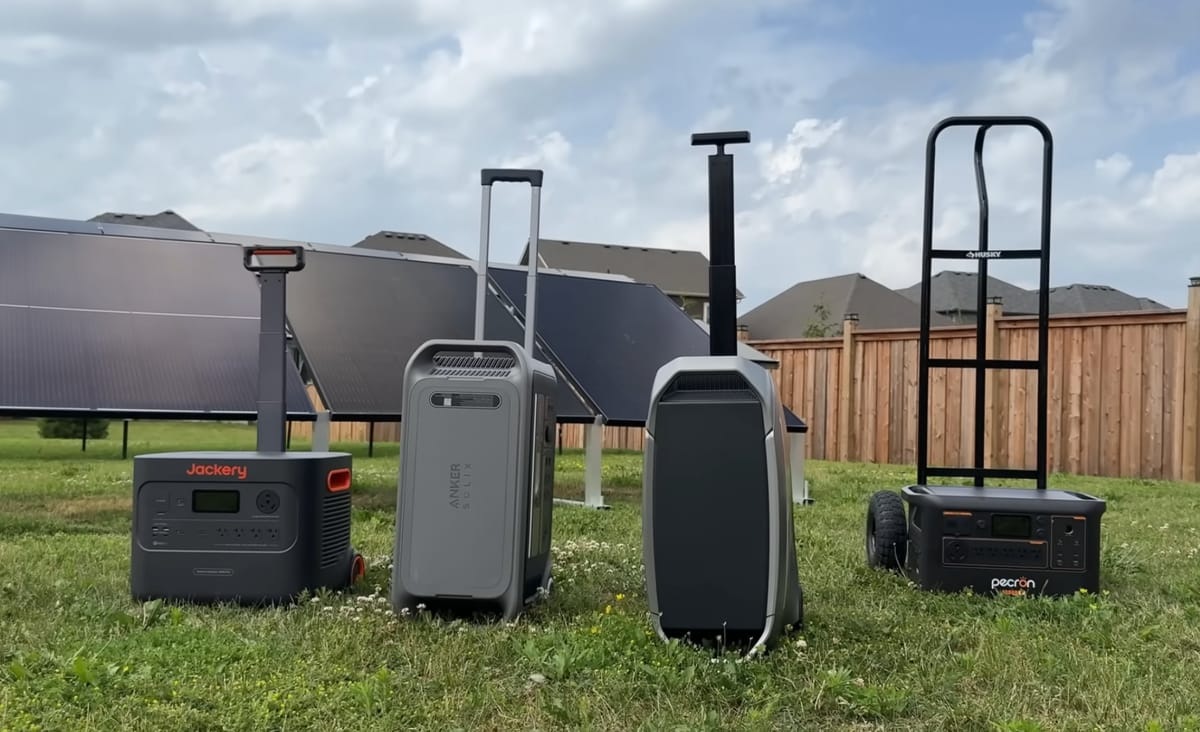
The Solar Lab put four of them side by side: the Anker SOLIX F3000, the Pecron F3000, the EcoFlow Delta 3 Ultra Plus, and the Jackery Explorer 3000 Pro. All 3,072Wh. All sold to do the identical job.
Here's what the extra money actually gets you. And, more usefully, what it doesn't.
The capacity is the same. Say it again.
This is the bit that should be on a billboard outside every caravan show in the country.
Three thousand and seventy-two watt-hours in the cheap one. Three thousand and seventy-two watt-hours in the expensive one. Your compressor fridge cannot tell which box it's plugged into. Your laptop can't. The little 12V fan you bought in a heatwave and now can't sleep without absolutely cannot.
The battery is not what you're paying the premium for. Not one single amp-hour of it. Anyone who tells you otherwise is either selling something or hasn't read the spec sheet.
So park the capacity argument. It's settled. Everything from here is about the stuff around the battery — and some of that stuff genuinely matters, while some of it is just very expensive plastic.
The apps: brilliant, and mostly pointless
Every one of these brands leads with its app. Live monitoring, remote on/off, UPS settings, charge limits, firmware over the air. All of it.
Anker's and EcoFlow's apps are, hands down, the best in the business. That's not really in dispute — it's why the other brands have been scrambling to catch up. Pecron's app does all the same jobs. It is not as polished. It looks like it was designed by an engineer rather than a designer, which is because it almost certainly was. But it works.
And here's the honest question nobody asks in a review: how often do you actually open it?
For most people the answer is twice. Once to set the charge limit at 85% so the battery doesn't spend its life sat full and slowly hating you for it. Once more to push a firmware update. After that it sits in a folder on page four of your phone with the other apps you downloaded for a specific van-related reason and never touched again.
If you genuinely enjoy watching a real-time power draw graph while you eat your beans — and some people do, no judgement — the premium app is worth a couple of hundred quid to you. If you're a set-it-and-forget-it type, you are paying a designer's salary for a screen you'll see twice a year.
Build quality is where the money is real
Right. This one is not marketing.
Pick up the Anker F3000 and you can feel where the R&D budget went. The plastics are thick. The handles don't flex. The whole unit has that reassuring density that tells you if it goes off the back of the van onto a gravel pitch, you'll get scuffs and scratches rather than a cracked housing and a very expensive lesson.
The Jackery Explorer 3000 Pro is the awkward one. It's one of the expensive units here, and it feels worse in the hand. The plastics are thinner and slightly hollow-sounding. The input flap on the back is stiff to the point of being genuinely annoying — after the third or fourth time your fingertips actually hurt. Despite being called the Explorer.
And it's the sockets. On the Anker, four plugs, each rotated a different way, so bulky power bricks aren't elbowing each other. On the Jackery, they're not spaced properly and they're not rotated at all — so you get the sliding-door scenario from the top of this article, every single time you set up.
These are decisions that never appear on a spec sheet. They also happen to be the decisions you'll notice every single day for the next six years.
The Pecron, meanwhile, is honest about what it is. It does not feel premium. The fit and finish aren't close to the Anker's. But it hands you nearly all the same ports, plugs and functionality for hundreds of dollars less. It's a work boot, not a brogue.
Wheels and handles: the spec nobody mentions until it's too late
Some of these units weigh between 70 and 100 lb. That's 32 to 45kg. That is a bag of building sand with a lithium battery inside it.
If it lives in a cupboard and moves once a year, fine, ignore this section. If you're loading it into a van, wheeling it across a campsite, or lugging it about during a power cut, it becomes the single most important thing about the product.
Anker have nailed it. Press the button, spring-loaded handle pops straight up, big wheels, and the thing rolls like decent luggage. Someone at Anker clearly spent a fortnight just moving the prototype around a room, and it shows.
Jackery has wheels and a telescoping handle, but no spring assist. On its own you'd never notice. Sat next to an identically-priced competitor that does have it, it looks like a corner cut.
EcoFlow lands in the middle — good wheels, solid handle, no complaints, just not as nicely resolved as the Anker.
The Pecron has no wheels and no telescoping handle at all. That's the trade for the money you saved. Garage to camper, truck to pitch — fine. Moving it constantly — you're either carrying 70-odd pounds several times a week or you're buying a sack truck. Not a dealbreaker. Absolutely something to budget for.
If portability matters to you, treat the handle and wheels as a headline spec, not a footnote. Your back keeps score.
The 30 amp plug: a selling point that has stopped selling anything
Every single one of these units has a built-in 30 amp RV outlet. The $850 Pecron. The $2,000-plus EcoFlow. All of them.
So if you're about to spend an extra grand because the expensive one has a 30A socket — don't. It's a standard feature on 3000W-class power stations now. It hasn't been a differentiator for a couple of years.
There is a wrinkle, though, and it's a proper one. A 30A US RV plug at 120V wants 3,600W to actually deliver 30 amps. The Delta 3 Ultra Plus and the Pecron F3000 both put out 3,600W, so their 30A sockets are real. The Jackery Explorer 3000 Pro tops out at 3,000W — which is 25 amps at 120V. The socket's there. You just can't fill it.
A note for anyone reading this in Britain: the 30 amp RV plug is a North American fitting, on a 120V system, and it's essentially irrelevant to you. Our hookup is a 16A blue commando at 230V — which, pleasingly, works out at about 3,680W, near enough the same power through a completely different plug. So don't let a US review talk you into paying for a socket you will never once use on this island. What you should be checking is the continuous AC output in watts and whether the unit is a 230V model at all.
Expandable batteries: the one upgrade genuinely worth paying for
If there's a single feature on this list that justifies real money, it's this.
The EcoFlow Delta 3 Ultra Plus, the Anker F3000 and the Pecron F3000 all take expansion batteries. Double, triple, quadruple your capacity later, when you know what your actual usage looks like rather than what you guessed it would look like in a spreadsheet in January.
The Jackery Explorer 3000 Pro does not expand. What you buy is what you have, for the life of the unit.
For plenty of people that's completely fine — 3kWh is a lot of power and most weekend setups never trouble it. But if this is going to be a home backup system, or you've got half an idea that you might add a compressor fridge, a diesel heater and an induction hob over the next two winters, buy into a system that grows. The alternative is buying an entire second power station in eighteen months, which is the most expensive way there is to save money.
Customer support doesn't scale with price
You'd assume the pricier brand answers the phone faster. It does not reliably work like that.
Anker have been around a long time, with large support teams and service centres, and they've built a reputation for actually sorting problems out. Reasonable odds of getting a human and a replacement.
EcoFlow are the most expensive units in this comparison and, in The Solar Lab's experience, the worst to deal with. Spending the most guarantees you precisely nothing.
Pecron, three years ago, wouldn't have made this conversation at all. Their support was rough. It's improved dramatically — faster responses, actually acting on feedback, standing behind the product. There's a telling anecdote here: a Pecron F1000 developed a fault between the BMS and the inverter, unfixable remotely. The Solar Lab rang up without saying who they were — no reviewer leverage, no channel name — and Pecron sent a replacement without a fight.
That's the only Pecron failure in the whole test, incidentally. Are they at Anker's level yet? Probably not. But if support was the thing keeping you away from the budget option, that reason is a lot weaker than it used to be.
So — is it worth spending more?
It comes down to one question, and it isn't "which is best".
If you need a box that runs a fridge, lives in the van and comes camping, the cheap one makes a very strong case. Same capacity. Same 30A outlet. Same ability to run your appliances. It will not know it was cheap and neither will your kettle.
Where the premium brands earn it is everything around the battery. Better plastics. Better handles. Better app. Better socket layout. A user experience that has clearly been argued about in a meeting somewhere. These are things you don't think about in the buying phase and notice constantly in the owning phase.
Is that worth $500 to $1,000? For some people, genuinely yes — if you're moving the thing weekly, working off it, living in it, those details stop being details.
But if you just want reliable power and you don't care about the fanciest app or the nicest wheels, it's very hard to make the case for the extra grand. Especially when that grand buys you another 400W of solar on the roof, or a second expansion battery, or a diesel heater that actually works — all of which will change your life in the van considerably more than a spring-loaded handle.
Don't buy the most expensive power station because it's the most expensive. Buy the one with the features you'll actually use.
I made the mistake of thinking that if I had the capacity to generate 2kW of power, I could manage full-time van life. I’d be right, but there’s the issue: I barely have 2kW. Running things at night leaves me with a deficit in the morning, and that one 200w solar panel just doesn’t quite cut it.
The verdict
Two clear winners, for completely opposite reasons.
Pecron F3000 — if you're building something semi-permanent. A cabin, a static conversion, a van where the unit gets strapped down once and stays there. You lose the wheels and the polish, you keep the capacity, the 3,600W output and the expandability, and you keep roughly a thousand dollars.
Anker SOLIX F3000 — if the thing is going to move constantly. Job site, campsite, in and out of the van every weekend. The handle and wheels alone justify a chunk of the gap, and the build quality justifies the rest.
EcoFlow Delta 3 Ultra Plus — excellent hardware, best-in-class app, 3,600W output, expandable. Just be aware you're paying top money and the support experience has been the weakest of the four.
Jackery Explorer 3000 Pro — the difficult one. Expensive money, thinner plastics, no spring assist, no expansion, and a 30A socket it can't fully drive at 3,000W. Hard to recommend when the competition is this good at the same price.
Spec teardown
| Pecron F3000 | Anker SOLIX F3000 | EcoFlow Delta 3 Ultra Plus | Jackery Explorer 3000 Pro | |
|---|---|---|---|---|
| Capacity | 3,072Wh | 3,072Wh | 3,072Wh | 3,072Wh |
| AC output | 3,600W | See note below | 3,600W | 3,000W |
| True 30A RV plug | Yes | See note below | Yes | No (25A at 120V) |
| Expandable | Yes | Yes | Yes | No |
| Wheels / telescoping handle | No | Yes, spring-assisted | Yes | Yes, no spring assist |
| App | Functional, unpolished | Class-leading | Class-leading | Adequate |
| Approx. price (US) | ~$850 | Mid | $2,000+ | Mid–high |
Note: the source video names only the EcoFlow and the Pecron as having true 30A output at 3,600W, which implies the Anker sits below that. Anker's own published spec for the SOLIX F3000 is higher. Check the current datasheet before you buy on that basis.
How they actually shook out
| Category | Winner | Loser |
|---|---|---|
| Build quality | Anker | Jackery |
| App | Anker / EcoFlow | Pecron |
| Portability | Anker | Pecron |
| Expandability | Three-way tie | Jackery |
| Customer support | Anker | EcoFlow |
| Value for money | Pecron | EcoFlow |
Shop via A Van Life Thing
If you buy anything on Amazon after clicking our link, we earn a small commission at no extra cost to you. It's a dead easy way to support the site while you're shopping for kit anyway.
Shop on Amazon### Are expensive power stations actually worth the money?
Not for the battery — a $850 3kWh unit and a $2,000 3kWh unit hold identical energy. The premium buys build quality, a more polished app, better wheels and handles, and smarter socket layout. If you move the unit often or use it daily, that's worth real money. If it sits in a cupboard and runs a fridge, it isn't.
Do all portable power stations have a 30 amp RV plug?
Effectively yes, on 3000W-class units — it's a standard feature now, not a differentiator, and it's on both the cheapest and most expensive models here. The thing to check is whether the unit can actually deliver 30 amps: at 120V that needs 3,600W of continuous output. A 3,000W unit only manages 25A through that socket.
Does a 30 amp RV plug matter in the UK?
No. It's a North American 120V fitting. UK campsites and hookups use a 16A blue commando connector at 230V, which delivers roughly 3,680W. Ignore the 30A marketing entirely and check the continuous AC output in watts, plus whether the model is sold in a 230V version at all.
How much power station capacity do I actually need for a van?
3kWh (3,072Wh) is generous for most conversions — it'll run a compressor fridge, lights, laptops and a diesel heater's glow plug for several days without sun. Where it gets tight is induction hobs, kettles and hair dryers. If there's any chance you'll add high-draw appliances later, buy a model that takes expansion batteries rather than one you'll have to replace outright.
Is the Jackery Explorer 3000 Pro a bad power station?
Not bad — just poorly positioned. It's a competent 3,072Wh unit, but at a similar price to rivals it has thinner plastics, no spring-assisted handle, no expansion battery support, and a 3,000W output that can't fully drive its own 30A socket. The hardware works; the value case is what struggles.