The Van Life Thing 0% Beer Showdown: Taste, Calories & Carbs
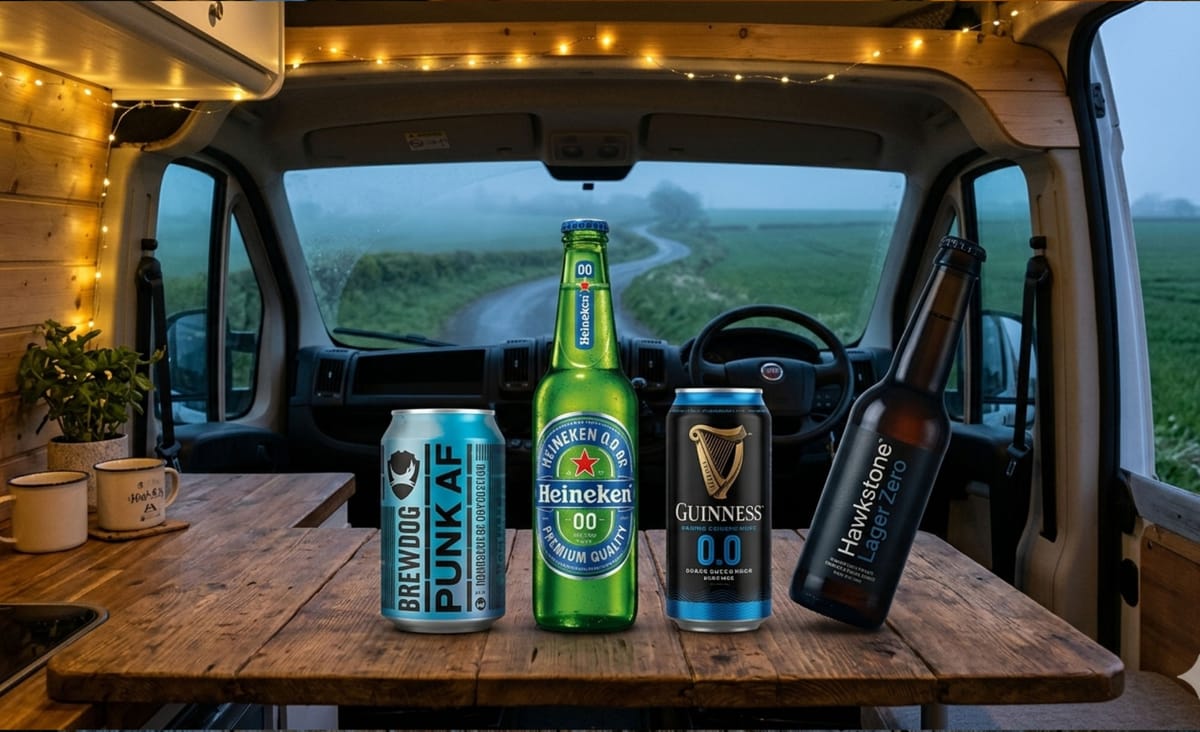
There’s something about cracking open a beer when you've parked up in an easy spot taking in your surroundings and you might even hear a distant sheep farting on the breeze.
But let's be honest, van life is not easy. It is a constant struggle just to find a flat place to park up and have a proper lie-in, let alone somewhere you can grab a beer and safely sleep off a hangover when you live in your vehicle.
Due to recent health stuff—two heart attacks, cheers body—I’m off the sauce for a while. But that doesn’t mean I’m giving up the ritual of beer altogether. Enter the world of non-alcoholic beer, which is currently hitting the exact same massive popularity that gluten-free products reached in their heyday before quietly shrinking back into a dedicated corner of the supermarket aisle. A zero beer with actual taste handles that basic need to keep your hands busy during the week, but almost every brewer wants to be the company that has you spending more money on a product that has less.
The Tax-Free Cash Grab
They love to blame the extortionate shelf price on the high-tech kit needed to strip the booze out. BrewDog co-founder James Watt went directly on record about this in an industry interview with Good Beer Hunting, explicitly stating that a can of Punk AF is actually more expensive for them to produce than a standard 5.4% boozy Punk IPA. His argument is that while both versions use the exact same amount of pricey hops and malt, the 0.5% version takes longer to process, uses massive quantities of lactose to fake the mouthfeel, and has to be run on a smaller, less efficient brewing system. As he put it: “So we save a bit on duty, but the liquid itself costs us more.”
Pull the other one, James. It sounds incredibly convincing until you look at the wider corporate context. Even before their massive brand buyout drama covered by The Guardian, they were a massive global presence raking in millions. The truth is, when you look past the corporate marketing talk and the "high-tech investment" excuses, the actual math on UK tax laws proves we are still getting absolutely taken for a ride.
Take a look at the shelf prices at Morrisons for a prime example: a 4-pack of Hawkstone Session Lager (4% ABV) sits at £8.50, while the Hawkstone Zero (0.5% ABV) is £7.00. At first glance, you think you're getting a decent deal on the zero because it's £1.50 cheaper.
But a standard 4-pack of 330ml bottles gives you 1.32 litres of liquid. At 4% ABV, that boozy box contains 0.0528 litres of pure alcohol, meaning the brewery has to pay the government £1.19 in packaged beer duty. Toss in the 20% VAT (£1.42), and the total tax paid straight to the taxman on the normal pack is £2.61. That leaves Hawkstone with £5.89 to cover their farming, brewing, glass, and profit.
Now look at the £7.00 Hawkstone Zero. Because it sits at 0.5%, it pays exactly £0.00 in alcohol duty. It also completely bypasses the UK sugar tax levy because it is legally classified as a beer substitute. The only tax on it is the 20% VAT, which is £1.17.
Do the final math: Hawkstone keeps £5.89 from the alcohol pack, and they keep £5.83 from the 0% pack. The net revenue for the brewery is virtually identical. They pass a tiny fraction of the tax savings to you to make it look like a bargain, and then pocket the rest of the difference. They are raking home a massive premium margin for flavored water that completely bypasses the taxman.
The Metabolic Sting
And it isn't just your wallet taking a hit—it's your metabolism, too. The front of these cans scream "0.0% Alcohol" to create a massive health halo. Taking the booze out obviously gives your liver a break, and the natural antioxidants left in the hops can help lower blood vessel inflammation. But there is a massive metabolic sting in the tail that they don't print on the front.
In a normal beer, the yeast eats up almost all the sugars from the malt and turns them into alcohol, leaving virtually zero grams of sugar behind. With 0% beer, they either kill the fermentation early or they strip the alcohol out and dump sugars and glucose syrups back into the liquid to try and fake the thickness and body of a real pint.
Flip the can around, and the numbers tell the real story:
| Beer Name | Serving Size | Alcohol (ABV) | Calories | Carbohydrates | Total Sugar |
|---|---|---|---|---|---|
| BrewDog Punk IPA | 330ml Can | 5.4% | 141 kcal | 9.9g | ~0.2g |
| BrewDog Punk AF | 330ml Can | 0.5% | 33 kcal | 10.0g | 1.7g |
| Heineken Original | 330ml Bottle | 5.0% | 139 kcal | 10.5g | 0.0g |
| Heineken 0.0 | 330ml Bottle | 0.0% | 69 kcal | 16.0g | 4.3g |
| Guinness Draught | 440ml Can | 4.2% | 155 kcal | 10.0g | 0.0g |
| Guinness 0.0 | 440ml Can | 0.0% | 55 kcal | 16.7g | 3.1g |
When you drink normal alcohol, it forces your liver to stop releasing glucose, acting as a temporary brake on your blood sugar. With a 0% beer, that brake is completely gone. The glycemic index of alcohol-free beer sits at a massive 80 out of 100. If you are sitting in the captain's chair of the van and cracking three or four Heineken 0.0s or Guinness 0.0s just to keep your hands busy before bed, you are pumping a heavy load of fast-acting carbs and up to four teaspoons of straight sugar into your blood right before sleep. Your liver isn't processing alcohol, but your pancreas is working overtime processing a massive sugar spike while you are completely inactive.
The Master Sugar Rankings: From Sugar Bombs to Zero Drop
To expose what’s actually going on across the wider market, I compiled the data for ten of the most common alcohol-free options hitting UK shelves.
When you line them up by their sugar content, you can see a massive divide. On one end, you have traditional wheat beers using natural, heavy sugars. In the middle, you have the mainstream macros dumping sugar in to fake the flavor. And at the absolute bottom, you have the clean brews trying to break the cycle.
Here is how they stack up, ranked from highest sugar to lowest:
| Product | Sugar (Per 100ml) | Sugar (Per Bottle/Can) | Pack/Bottle Size |
|---|---|---|---|
| Erdinger Alkoholfrei | 3.6g | 18.0g | 500ml |
| Krombacher Weizen AF | 2.7g | 8.9g | 330ml |
| Sainte Etienne (Aldi) | 2.1g | 10.5g | 500ml |
| Rheinbacher Pilsner (Aldi) | 2.0g | 6.6g | 330ml |
| Guinness 0.0 | 1.5g | 6.3g | 420ml |
| Heineken 0.0 | 1.3g | 4.3g | 330ml |
| Lucky Saint | 1.0g | 3.3g | 330ml |
| BrewDog Punk AF | 0.5g | 1.7g | 330ml |
| Hawkstone Zero | 0.4g | 1.3g | 330ml |
| Impossibrew Lager | 0.0g | 0.0g | 440ml |
| Category Average | 1.7g | — | — |
Looking at that 1.7g category average, it becomes pretty clear why your palate changes when moving between these. Cracking a 500ml Erdinger drops a massive 18 grams of sugar straight into your system—that's more than half a glass of Coca-Cola before bed.
With the context out of the way, I sat down in the van to see how the actual liquids hold up.
The Main Lineup Reviewed
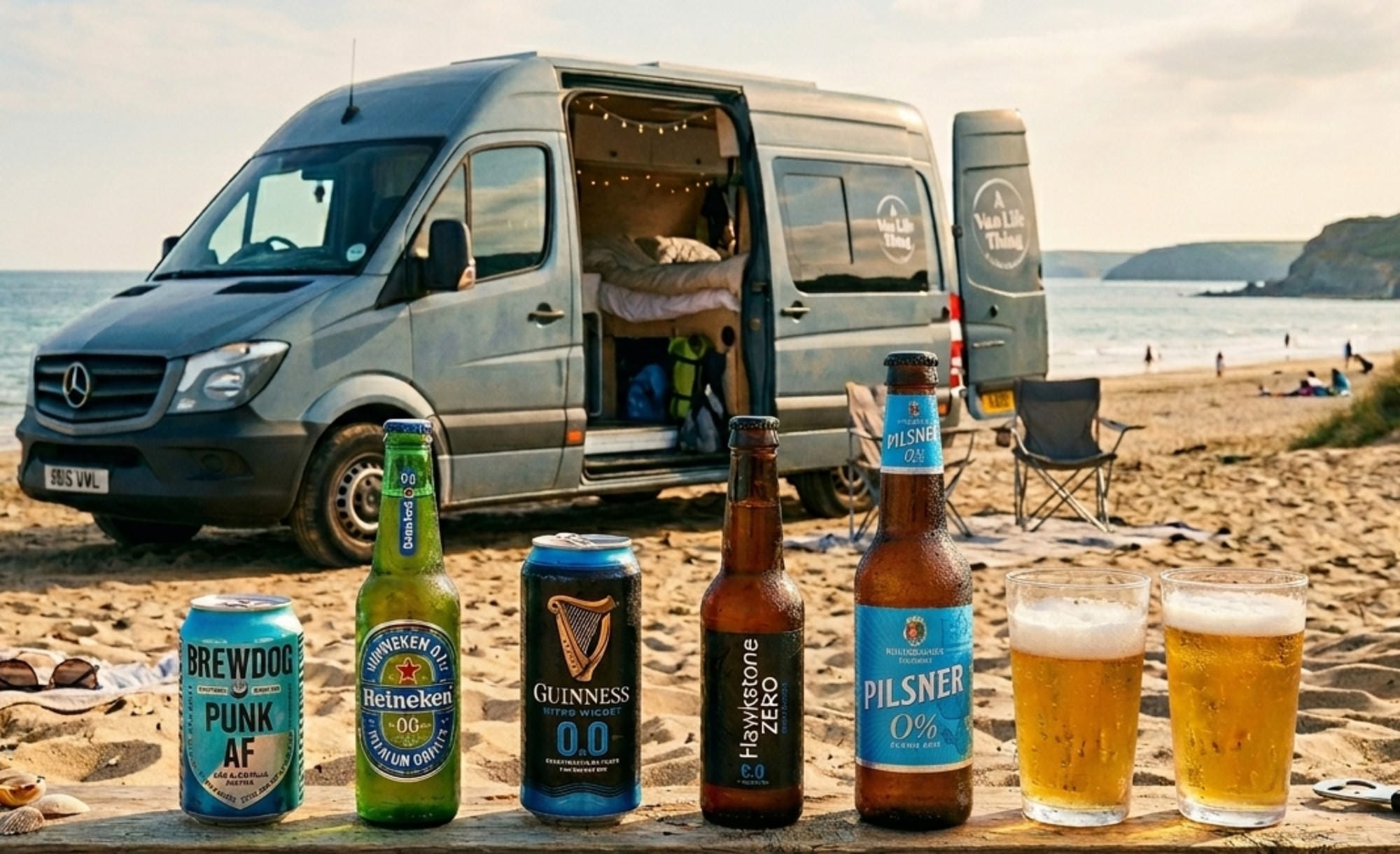
BrewDog Punk AF
A booze-free twist on their classic Punk IPA.
Stats (Per 100ml): 15 kcal | 3.0g Carbs | 1.8g Sugar
The Taste Test
Smell-wise, that definitive BrewDog aroma is there, but dialled down like Punk IPA’s quieter, less rowdy little brother. You get that hint of citrusy hops, but without the booze-breath intensity.
And here’s the weird bit—it instantly made me think of the seaside. You know those summer days when there’s a salty breeze in the air and, without warning, your brain goes “fish and chips, now”? That’s what this smell does. It’s not that it smells of fish, obviously, but there’s something about it that nudges your memory—sun-warmed seafronts, a bit of sand stuck to your chips, and the unmistakable scent of vinegar wafting from someone else’s newspaper parcel. It’s nostalgia in a can, in a roundabout, hoppy way.
The first sip of the taste test is alright—clean, light, a bit of fruit and bitterness. Those citrus and pineapple notes show up again, leaving a grapefruit aftertaste.
The Metabolic Reality
But the further down the can you get, the more it falls apart. Like a lot of 0% beers, the ingredients start separating in your mouth. It's exactly like a badly organized school science experiment with a jar of oil and water—the flavours just refuse to mix. You get a flash of citrus, then a watery gap, and then this dry, metallic, gritty finish at the end. You can tell exactly how it was made—they’ve stripped it back and then thrown in a splash of generic concentrate at the end to try and fake the body.
The Verdict
It’s not a total disaster if you just want the ghost of an IPA without the booze, but you definitely know you're drinking a compromise.
Rating: 3.8 / 5
Heineken 0.0
A mainstream juggernaut that completely surprised me.
Stats (Per 100ml): 21 kcal | 4.8g Carbs | 1.3g Sugar
The Taste Test
What really caught me off guard with Heineken 0.0 is how nicely blended it feels. Remember that badly organized school science experiment I just mentioned with the Punk AF? The oil and water refusing to mix? Heineken completely avoids that trap. There’s a light maltiness, just enough sweetness to feel familiar, and a clean, crisp finish that doesn’t hang around too long. No big drama, no flavour clumps fighting each other. It’s smooth and actually feels like one complete drink—not a bunch of separate ingredients pretending to get along.
And here’s the kicker: it doesn’t even taste like regular Heineken. The full-fat Heineken—especially the stuff we get in the UK—has always felt heavy and claggy to me, like you are chewing your way through an 8% can from the corner shop that manages to be both watery and overly sweet at the same time. It’s the pint you order when the other taps have betrayed you.
The Metabolic Reality
It’s brewed from scratch, not just dealcoholised, and they’ve used vacuum distillation to preserve the flavour properly rather than just watering it down and hoping for the best. The downside? That smooth flavor comes at a cost of 4.3 grams of sugar per bottle, sitting right in the middle of our sugar scale.
The Verdict
Crucially, Heineken 0.0 doesn’t leave me wishing I had the alcoholic version in my hand instead. That’s where a lot of these beers fall flat. It’s a decent beer in its own right.
Rating: 4.2 / 5
Guinness 0.0
An iconic stout attempting a legendary vanishing act.
Stats (Per 100ml): 17 kcal | 3.8g Carbs | 0.7g Sugar
The Taste Test
This one gave me mixed emotions. They've been making bold claims about "same taste, no alcohol," which is a tall order for a drink that iconic. It still comes with the familiar nitro widget in the can, so you get that satisfying surge and settle effect. You can just dump it into a glass if you’re in a rush, but if you want the proper creamy head and smooth mouthfeel, it’s worth giving it the two-part pour treatment. It’s the beer equivalent of lighting candles for your takeaway.
Visually, it looks spot on with the rich black body and foamy tan head, but the foam is definitely more lively. It has more pop and less cushion, almost like a yeasty bubble bath fizzing away instead of settling into a dense cloud. That’s down to the lack of alcohol acting as a stabilizer.
When you take a sip, you get that classic Guinness glide that gently coats the back of your throat, bringing the expected roasted malts and coffee bitterness.
The Metabolic Reality
But it stops just short. The full Guinness gives you that warmth, that heft, and that little internal hug after a long day. This version hits the beats, but the crescendo never comes. It’s like drinking Guinness on mute—all the right notes, but none of the bass.
The Verdict
The mouthfeel is just a touch thinner, and while it holds together from the first sip to the last without falling into the common trap of being all fizz and no flavour, the edge is definitely softened. It’s a brilliant understudy rather than the headliner.
Just in case you are wondering if it's legal to drink in your van whilst stealth camping, I've done a whole separate article about that [here].
Rating: 3.5 / 5
Hawkstone Zero: The "Steamed Veg" of the Beer World
If you’ve read the intro to this post, you already know my thoughts on Hawkstone's corporate pricing strategy. But what happens when you stop looking at the profit margins, pop the cap, and actually drink the stuff?
On paper, Hawkstone Zero looks incredibly clean. But to understand just how clean it is, you have to look at it side-by-side with the competition:
The Macro Metric Showdown (Per 100ml)
| Beer | Calories | Carbohydrates | Of Which Sugars |
|---|---|---|---|
| Hawkstone Zero | 13 kcal | 2.6g | 0.4g |
| BrewDog Punk AF | 15 kcal | 3.0g | 1.8g |
| Guinness 0.0 | 17 kcal | 3.8g | 0.7g |
| Heineken 0.0 | 21 kcal | 4.8g | 1.3g |
When you see the data laid out like this, the real story jumps off the page. Hawkstone sits at the bottom of every single column. It has almost half the calories of a Heineken 0.0, and more importantly, it has over four times less sugar than a BrewDog Punk AF.
The Taste Test
Compared to heavy hitters like Heineken 0.0, Hawkstone initially feels like it lacks a real punch. It's exceptionally light—bordering on fresh water—but it does manage to hold onto a decent mouthfeel. Crucially, it completely avoids that syrupy, slimy texture that plagues so many alcohol-free lagers when breweries dump unfermented sugars or thickeners into the batch to fake the body of a real pint.
Carbonation-wise, it isn't any fizzier than the budget brands you’d pull out of an Aldi or Lidl middle aisle. It’s crisp, sharp, and clean.
The Sugar Blindness Reality
When you line Hawkstone up next to macro non-alcoholic beers, the flavor can feel lacking at first glance. But you have to ask yourself why.
The Steamed Vegetable Analogy: Drinking Hawkstone Zero is like eating a plate of clean, steamed vegetables after months of processed food. It tastes incredibly healthy and fresh, but your palate is so completely blinded by the standard industry sugar overload that you don't appreciate the natural flavors at first.
Hawkstone hasn't cheated. They haven't crammed the bottle full of fast-acting carbs and sugars just to trick your brain into thinking it's drinking a full-fat lager.
The Verdict: Is it worth a spot in the van fridge?
Yes, you are absolutely paying a premium for the "Diddly Squat" experience and Jeremy Clarkson's branding. And yes, those tax loop-hole margins are part and parcel of how these major companies operate.
But if your funds allow for it, this one is genuinely worth it. It’s a clean, sugar-conscious brew that respects your pancreas, and at the end of the day, it's the definitive UK version of supporting local British farming.
Rating: 3.5 / 5 (Bonus points for skipping the sugar bomb status).
Rheinbacher Pilsner(Aldi)
Stats (Per 100ml): 22 kcal | 4.8g Carbs | 2.0g Sugar
The budget option that punches well above its weight class—with a catch.
The Taste Test
his was one of my favourites of the lot due to having a unified taste that didn't separate as you drink. With so many non-alcoholic beers, you get the initial flavour hit, then a watery gap that has some taste, and then a bottom drop-off which is absolutely nothing. Rheinbacher Pilsner completely skips that structural failure; it swims down beautifully, being exceptionally nice and light to drink.
The Metabolic Reality
But there's a reason it flows so nicely, and it goes right back to our master table. The sugar content on this budget pilsner is among the highest on the list (2.0g per 100ml, resulting in 6.6g per bottle). Now that I know about the sugar metrics, I genuinely do notice a distinct stickiness when drinking it.
The Verdict
Because of that heavy sugar profile, this is absolutely not a drink for a late evening "YouTube and chill" session in the van—if you drink a couple of these before bed, your blood sugar will spike so hard you'll never get to sleep. Keep this one strictly as a sunny afternoon drink when you are active, not an evening nightcap if you value your rest.
Rating: 4 / 5
The Master Sugar Rankings: From Sugar Bombs to Zero Drop
To expose what’s actually going on here, I compiled the data for ten of the most common alcohol-free options hitting UK shelves.
When you line them up by their sugar content, you can see a massive divide. On one end, you have traditional wheat beers using natural, heavy sugars. In the middle, you have the mainstream macros dumping sugar in to fake the flavor. And at the absolute bottom, you have the clean brews trying to break the cycle.
Here is how they stack up, ranked from highest sugar to lowest:
| Product | Sugar (Per 100ml) | Sugar (Per Bottle/Can) | Pack/Bottle Size |
|---|---|---|---|
| Erdinger Alkoholfrei | 3.6g | 18.0g | 500ml |
| Krombacher Weizen AF | 2.7g | 8.9g | 330ml |
| Sainte Etienne (Aldi) | 2.1g | 10.5g | 500ml |
| Rheinbacher Pilsner (Aldi) | 2.0g | 6.6g | 330ml |
| Guinness 0.0 | 1.5g | 6.3g | 420ml |
| Heineken 0.0 | 1.3g | 4.3g | 330ml |
| Lucky Saint | 1.0g | 3.3g | 330ml |
| BrewDog Punk AF | 0.5g | 1.7g | 330ml |
| Hawkstone Zero | 0.4g | 1.3g | 330ml |
| Impossibrew Lager | 0.0g | 0.0g | 440ml |
| Category Average | 1.7g | — | — |
Looking at the 1.7g category average, it becomes pretty clear why your palate changes when moving between these. Cracking a 500ml Erdinger drops a massive 18 grams of sugar straight into your system—that's more than half a glass of Coca-Cola before bed.
Let’s dive into how this data actually translates to flavor when you pop the caps.
| Product | Per 100ml | Per bottle | Bottle size |
|---|---|---|---|
| Erdinger Alkoholfrei | 3.6g | 18.0g | 500ml |
| Krombacher Weizen AF | 2.7g | 8.9g | 330ml |
| Sainte Etienne (Aldi) | 2.1g | 10.5g | 500ml |
| Rheinbacher Pilsner(Aldi) | 2.0g | 6.6g | 330ml |
| Guinness 0.0 | 1.5g | 6.3g | 420ml |
| Heineken 0.0 | 1.3g | 4.3g | 330ml |
| Lucky Saint | 1.0g | 3.3g | 330ml |
| BrewDog Punk AF | 0.5g | 1.7g | 330ml |
| Hawkstone Zero | 0.4g | 1.3g | 330ml |
| Impossibrew Lager | 0.0g | 0.0g | 440ml |
| Category average | 1.7g | — | — |
The Post-Drive Verdict
At the end of the day, the 0% beer scene isn't quite the health paradise the marketing teams want you to believe. We are definitely paying a premium for fancy flavored water, and if you aren't careful, your pancreas will be working a heavy night shift processing sugar while you're trying to sleep.
But if you want to keep the ritual alive without the hangover:
- The Winner: Heineken 0.0 is the clear standout for a smooth, cohesive taste that doesn't feel like a compromise.
- The Runner-Up: BrewDog's Punk AF gives a great hit of seaside nostalgia but falls apart completely on the gritty finish.
- The Understudy: Guinness 0.0 looks stunning and hits the right notes, but ultimately leaves the bass slider at zero.
The ritual of a post-drive beer is a hard habit to break when you finally park up for the night. Having a few decent alcohol-free options in the van fridge is a massive win—just keep an eye on those carbs before you hit the sack.
What's currently sitting in your van fridge? Let me know your top picks (or worst offenders) in the comments!