Sprinter Build Ep4 - Battle Of the Bulkhead
I spent an afternoon undoing every bolt across the bulkhead, then discovered only two of them were actually holding it in. That was the easy part. The wiring behind it turned one video into a two-parter, and here's why.

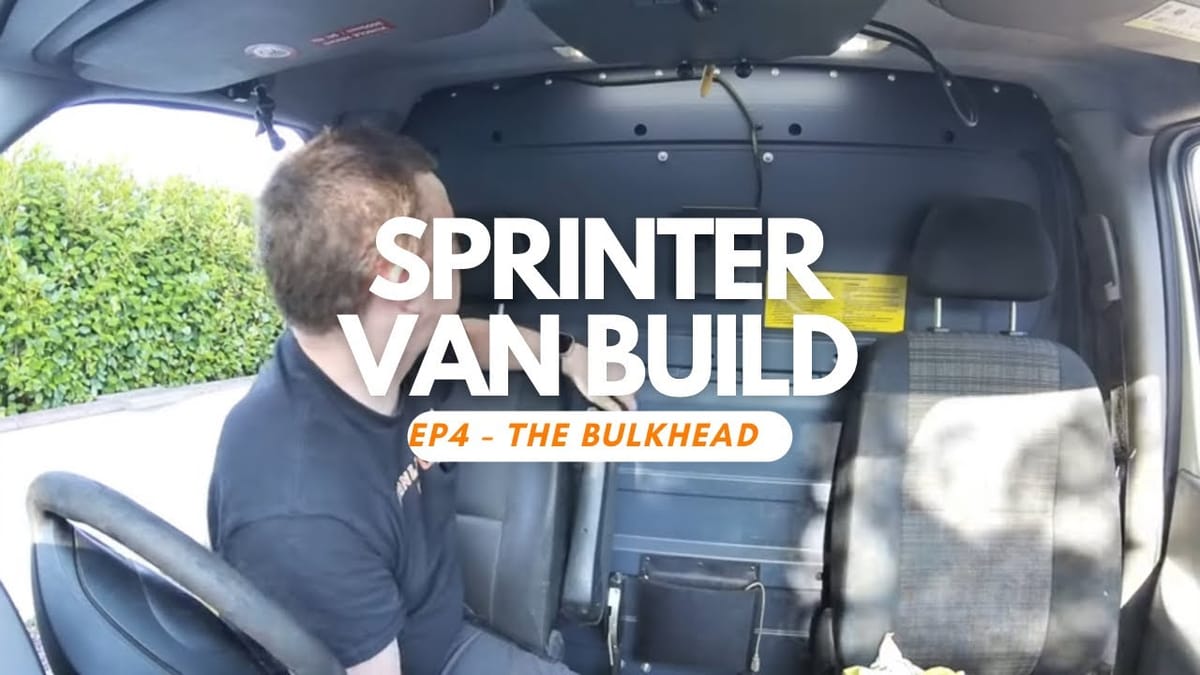
I'd been working my way methodically across the top of the bulkhead for the best part of an afternoon. Socket on, bolt out, move along. Some of them fought. One of them spun uselessly for ten minutes against a nyloc nut I couldn't reach. All of them came out eventually.
Then I got round to the back, had a proper look, and realised the whole assembly was actually held in by two bolts. Two. Sitting there in plain sight. Everything else I'd removed was doing precisely nothing structural.
I could have done the job in about four minutes.
First, the van wouldn't start
Before any of that, there was the small matter of the van being dead.
Week and a half away with work, came back, turned the key, and got the specific silence that means you're not going anywhere. Accompanied, naturally, by the Battery Guard 3000 beeping merrily away at me — a device whose entire stated purpose is preventing exactly this from happening, and which had comprehensively not done so.
The battery on this particular Sprinter isn't where you'd expect it. It's under the passenger step, behind a cover that slides up and out once you've found the little symbol telling you it's there. Bit of sleuthing required if nobody's told you.
Jump pack on, engine run for a minute, and it fired.
On a 12V vehicle there is no "neutral" — there is positive and negative, and the order matters. Connect positive first, then take your negative to a bare metal earth point on the engine or chassis, not directly to the flat battery's negative post. A flat lead-acid battery vents hydrogen, and the last connection you make is the one that sparks.
I got the polarity right. I said "neutral" out loud on camera anyway, because I have the electrical confidence of a wet paper bag, and then triple-checked it and still didn't believe myself.
The actual cause: parasitic draw
The reason it went flat sitting on a drive for ten days is parasitic draw — something in the van quietly sipping current with the ignition off. On an ex-utility van that's practically guaranteed, because the previous fleet fitted trackers, beacons, radios and monitoring kit, and none of it was ever designed to be dormant for a fortnight.
I got the term from ChatGPT, which is a perfectly reasonable way to find out what a thing is called. It is not a way to find out which circuit is responsible.
That takes a multimeter in series on the negative lead and a systematic fuse-pull. Which is a different episode, and a different afternoon.
Talking to an actual human beat every forum I've read
Worth saying plainly: I'd been staring at the back of this van for weeks with no idea where to start.
I took it to SJ Body Repairs to ask about getting the PTO removed, and came away with more useful direction in twenty minutes than months of scrolling had given me. Two things in particular.
First: take the bulkhead out now, not later. I'd been planning to leave it and work around it. He pointed out that with it gone I could get backwards and forwards freely to trace cables, which makes every subsequent job easier. Obviously correct once said out loud.
Second: my half-formed idea about cutting the bulkhead down the middle rather than binning it entirely — he said he could just do that for me.
Facebook groups and WhatsApp are fine for morale. For actual decisions, find a bloke with a workshop.
Cutting it down rather than throwing it away
The plan isn't to remove the bulkhead completely. It's to cut it down so there's still a partial partition behind the seats.
Where to cut is a judgement call and I don't fully trust mine yet, so I taped a line further back than I actually want it. You can always trim more off. You cannot weld it back on and pretend it never happened.
I'm likely to bring it in as far as the arm rest, so there's something to lean against rather than a bare edge, and whatever's left is getting proper trim on it. Raw cut steel at shoulder height in a moving vehicle is how you acquire an interesting scar.
The fastener problems, and what actually works
| Problem | What worked |
|---|---|
| Bolt spins forever, nyloc nut behind it out of reach | Second spanner braced on the far side while you turn — awkward, but it breaks the spin |
| Fastener seized solid, no access | Drill it out. It's scrap, it owes you nothing |
| Drill bits going soft | Let them cool. Overheated bits stop cutting and start polishing |
| Debris landing in the cab | Drill from the far side so the swarf falls into the load area, not onto your seats |
| Panel about to drop on you | Move the camera. Then move yourself |
That last one isn't a joke. The reflex when something heavy lets go is to catch it, and catching a bulkhead section is not a thing you want to attempt.
And then the wiring stopped me dead
Here's where the video was supposed to end with a triumphant empty van, and instead ended with me looking at a fuse box like it had personally insulted me.
There's a box riveted into the bulkhead, stuffed with electrics, and it is live. I don't yet know whether it's fed from the starter battery or the so-called leisure battery, because there's no labelling, no diagram, and the cable runs disappear behind panels in three directions.
Behind that, a genuine spider's nest of loom going into a fuse box, with at least one heavy cable whose destination I still can't account for.
If a box is live and you can't trace where it's fed from, stop. Disconnect the battery negative before you go any further. "It's probably fine" is how people end up with a melted loom or a fire on a driveway.
I got overexcited. I genuinely thought the bulkhead would come out in one session. It's going to be a two-parter, because all of that cabling needs identifying and rerouting before anything else moves.
Would I buy an ex-Cadent van again?
For most people doing a van build, taking the bulkhead out is a genuinely simple afternoon. Undo some bolts, lift it out, done.
Ex-utility vans aren't that. You're not just removing a partition, you're removing a partition that a fleet electrician built an entire secondary electrical system into, twelve years ago, without documentation, in a way that made sense to him and nobody since.
The upside is real — the bodywork on these is usually looked after, the mileage is honest, and you get useful kit thrown in. The cost is that every job has a wiring problem hiding inside it.
If you're thinking about an ex-British Gas or Cadent van and you're not confident with 12V electrics, factor in an auto electrician's day rate before you bid. That's the honest version.
Follow along with my van build on YouTube and I'd appreciate a follow if you like what you see.
How do you remove a bulkhead from a Mercedes Sprinter?
Disconnect the battery negative first, then find the fasteners actually carrying the load — usually a small number of structural bolts, not the many trim and bracket screws around them. Free any wiring routed through or attached to the panel before you lift, and get a second pair of hands, because a full steel bulkhead is heavy and awkward. On an ex-utility van, budget a whole extra session for the wiring alone.
Do I have to remove the bulkhead for a camper conversion?
No, but it makes everything afterwards easier, particularly tracing and rerouting cables between the cab and the load area. A middle option is cutting it down to a partial partition, which keeps some of the structural bracing and a bit of separation from the cab while giving you access. Note that on some vans the bulkhead contributes to body stiffness, so check before removing it entirely.
What causes a van battery to go flat when parked?
Parasitic draw — accessories continuing to pull current with the ignition off. Ex-utility vans are prone to it because of trackers, beacons and monitoring gear left wired in. Diagnose it by putting a multimeter in series with the disconnected negative lead and pulling fuses one at a time until the reading drops. Anything above roughly 50mA at rest is worth investigating.
Is it safe to leave a battery guard or saver fitted to an old van?
A battery guard is meant to disconnect the load before the battery drops too low to start the engine, but it can only manage circuits it's actually wired into. If a parasitic draw sits on a circuit downstream of it, or the unit itself has failed, the battery still goes flat. Mine beeped for days and saved nothing. Treat one as a warning device, not a fix for the underlying draw.
How do you undo a bolt that just spins?
It's spinning because a nyloc or captive nut on the far side is turning with it. Get a spanner onto the nut and brace it while you turn the bolt head — even poor access is usually enough to break the spin. If you genuinely can't reach, drill the head off. On parts headed for the scrapyard that's the fastest route; on parts you're keeping, take the time to reach the nut properly.