Jackery Explorer 1000 V2: Honest Numbers After Proper Testing
The Jackery Explorer 1000 V2 is a genuinely decent bit of kit sold by a company that can't stop contradicting itself. The homepage implies 600W of solar. The back of the unit says 400W. Here's what testing found.
You're in a field. It's going dark, it's that specific kind of Welsh drizzle that gets inside your collar, and you're laying out six 100W folding panels in a fan across the wet grass because the website said six panels, three hours, job done.
You daisy-chain the lot. You plug in. The screen settles on something around 400 watts and refuses, politely but firmly, to go any higher.
Two of those panels — sixty-odd quid's worth of glass and fabric each — are doing absolutely sod all. They will continue to do sod all for the entire life of the unit. Because the number on the back of the box and the number on the front of the website are not the same number, and nobody at Jackery has thought that worth fixing in about four years.
That's the Jackery Explorer 1000 V2 in one soggy paragraph. It's a good power station. The company selling it cannot be trusted to describe it.
Where the numbers come from. The bench testing quoted throughout this piece — runtime, surge, charge times, pass-through behaviour — was done by The Solar Lab, not by us. We've checked their arithmetic, cross-referenced the official manual, and corrected two figures along the way. Credit where it's owed: they put the load bank on it.
What You're Actually Buying
Right, the boring bit first, because you need it to follow everything else.
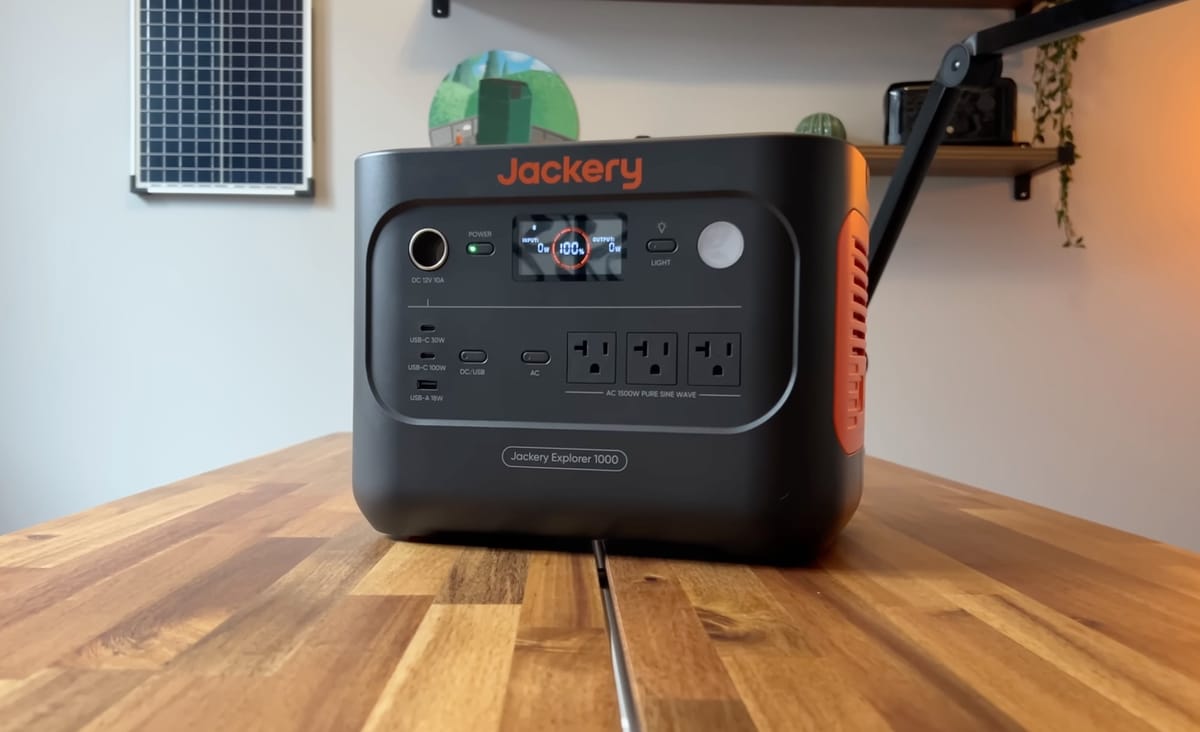
| Spec | Jackery Explorer 1000 V2 |
|---|---|
| Battery | 1,070Wh LiFePO4, rated 4,000 cycles to 70% capacity |
| Inverter | 1,500W continuous, 3,000W peak (claimed) |
| Weight | 23.8 lb (about 10.8kg) |
| AC charging | ~1,000W (1,200W in emergency mode) |
| Solar input | 400W max, via 2× DC8020 (8mm barrel) ports |
| Outputs | 3× AC, 2× USB-C (one 100W), 1× USB-A, 12V car socket, light |
| Backup switchover | 20ms EPS |
| Expandable | No — that's the Plus |
| Price | $799 retail, often less direct |
You can lift it one-handed off a tailgate without doing your back in, which is more than can be said for most of this class. The screen's clear and uncluttered. The app is, and it pains nobody more than me to say this, actually very good — clean, not overstuffed, and it lets you flick the inverter on and off from across a campsite so you're not crawling over a sleeping dog to press a button.
Shop via A Van Life Thing
If you buy anything on Amazon after clicking our link, we earn a small commission at no extra cost to you. It's a dead easy way to support the site while you're shopping for kit anyway.
Shop on AmazonThe Genuinely Good Bits
The handle
The new fold-flat handle is the best thing Jackery has done in years. It flips up to carry, folds away to stack, and it means you can put a crate of food on top of it in the boot instead of building a little shrine around it. Everything faces forward except the inputs, and the AC sockets have a small plastic flap behind them so a splash doesn't go straight into the mains side.
Emergency charging
Small batteries charge slowly. That's physics and economics, not malice. This one takes about 1,000W as standard, but there's a toggle in the app that pushes it to 1,200W for exactly one charge cycle, then switches itself off.
It's not dramatic. It shaves the charge from an hour and thirty-five down to just under an hour. But when you've realised at half seven in the morning that the thing is flat and you're leaving at half eight, that's the difference between packing a working battery and packing a paperweight. It's slightly bad for battery longevity, which is precisely why they won't let you leave it on.
The battery it's actually built around
Worth pausing on, because it's the bit that decides whether this is still working in 2035. It's LiFePO4, rated for 4,000 cycles before it drops to 70% of original capacity. Drain it and refill it every single day and you're past a decade before it's meaningfully degraded — and nobody uses a camping power station every single day.
There's a 20ms EPS switchover too, so if you're using it as home backup it catches a grid cut fast enough that the router doesn't reboot. Not a true 0ms UPS, and don't hang a desktop PC off it expecting miracles, but for keeping the broadband alive through a Storm Whatever power dip, 20ms is plenty.
One thing to know before you panic: it defaults to an energy-saving mode that kills the outputs after 12 hours if nothing's drawing meaningful power — under 2W on USB and the car socket, under 25W on AC. That's the correct behaviour, and it will still catch you out the first time you leave something tiny plugged in overnight and find it switched off in the morning.
The light
I will die on this hill. A power station with a built-in light is worth more than a power station without one, and most manufacturers have quietly dropped them.
Pumping up an air bed in a tent at eleven at night, one hand on the pump, is not the moment to be balancing a phone torch on a rucksack. The light on the front means you can see the valve. That's the whole review of the light.
Now the Website
This has been going on for years and it's the reason we keep having this argument.
Jackery's site is a maze of popups, and the specs are scattered around it like someone dropped a folder down the stairs. It'll tell you "fast charging" without telling you how fast. It'll say "solar input" without saying how much. You end up hunting through three sections to find a number that should be in a box at the top.
And when you do find the numbers, they don't agree with each other. One part of the site gives a 400W solar input. Another, higher up, cheerfully implies six 100W panels — 600W — for a three-hour charge.
The back of the unit says 400W. The back of the unit is correct.
If the product and the marketing copy disagree, the product is telling the truth. Always. Trust the sticker on the chassis, never the hero section.
This isn't a typo that slipped through. It's been flagged to them directly — emailed, spelled out — and the response was to ask whether they'd got it right. Somebody else needs to be in charge of the spec sheets, because the current arrangement takes a decent product and turns it into a trap. Buy this with six panels and you'll be furious when four of them are doing the work.
The Other Niggles
It doesn't expand. Fair enough at this size, and honestly I'd take a 1kWh unit camping and never think about expansion once. But plenty of rivals now make expandability the default on their small units, and Jackery makes you step up to the Plus to get it.
The solar connectors. MC4 is the industry standard. Everyone uses MC4. Jackery uses a proprietary 8mm DC barrel connector — DC8020 — and the practical effect is that your existing panels won't plug in at all without an MC4-to-DC8020 adapter.
It's the Apple move: not technically worse, just conveniently incompatible in a direction that happens to sell more Jackery panels. If you've already got a pile of solar in the garage, that's a proper kick in the teeth, and it's one more cable to lose in a wet field.
Buying an adapter? It's MC4 to DC8020. Not MC3 — that's a different, older connector Jackery doesn't use on this unit, and the wrong adapter is a wasted order and a wasted weekend.
Customer service. Phone them and see. Their Trustpilot score has been sliding, and there's a comment under practically every review video from someone who nearly bought one and got scared off by the support horror stories.
Here's the awkward part: the hardware is good. A Jackery is what goes in the van for actual camping trips. Nobody's paid to say that and nobody's paid to say the rest of it either. But liking the product doesn't oblige anyone to defend the company, and right now Jackery is doing itself a serious disservice.
[Insert your specific story/anecdote here — your own experience with their support, spec confusion, or a trip where this unit did or didn't cope.]
The Numbers, Properly Tested
This is the part the website should have led with.
| Test | Result |
|---|---|
| Efficiency under near-max load (1,479W) | Ran 37.2 min against a theoretical 43.4 — roughly 86% |
| Surge, 1,560W | Held 10 minutes, at which point the test was abandoned |
| Surge, 2,200W | Brief blip, then shutdown — as expected |
| AC charge, 0–100% | 1 hr 35 min standard, just under 1 hr in emergency mode |
| Pass-through | Works, but tapers hard under load |
| Noise | Quiet. Genuinely quiet. |
That 86% is the headline — the video rounds it up to 87.5%, but the raw figures give a shade under 86, and either way it clears the bar. Anything above 85% on a small power station earns a thumbs up, and most of them don't manage it. Efficiency is the number that decides whether your kit actually runs through the night, because the gap between the sticker capacity and the usable capacity is where all your optimism goes to die.
Run a 100W draw — a heated sleeping bag, say — off roughly 920Wh of usable energy and you're looking at something in the region of nine hours. Enough for a cold night. Not enough for two.
Pass-through deserves a note. You can run a device while charging, which some units flatly refuse to do. But it throttles: pull 1,400W and almost nothing goes into the battery, pull 80W and it charges at nearly full speed. Useful, just don't expect to power a kettle and refill simultaneously.
Surge behaviour is reassuring, with one asterisk. Nudge over 1,500W and it copes rather than tripping out, which matters when a compressor fridge and a laptop charger decide to kick in at the same moment. It held 1,560W for ten solid minutes.
The asterisk: the manual claims a 3,000W surge peak, and in testing it gave up at around 2,200W — a brief blip, then off. Surge ratings are always measured over milliseconds under lab conditions, so this isn't quite the contradiction it looks like, but if you're buying this specifically to kick a 2.5kW motor into life, don't.
So Should You Buy One?
Yes. With one condition, and it's a condition I've never put on a review before.
Don't buy it from Jackery.
Buy it from a physical shop where you can stand in the aisle and read the specs printed on the carton. Whatever's wrong with Jackery's copywriting hasn't reached the packaging — the carton has been reliably honest where the website hasn't. Or go through a reseller whose entire job is wading through manufacturer nonsense and telling you the real number.
Buy from somewhere with a returns desk. If the spec turns out to be wrong, that's their problem to sort out, not a three-week email chain with a company that already got it wrong once.
The product isn't bad. That's why Jackery is still standing. The previous version had a hidden bit of nonsense baked into it that earned the company a proper kicking; this one has nothing weird going on. It works, it's efficient, it's quiet, the handle's lovely and the light is a small daily pleasure.
It's just sold by people who can't be trusted to tell you what's in the box.
Testing figures throughout are from The Solar Lab's review, Jackery 1000 V2 – When Will They Learn?. Worth eleven minutes of your time if you want to watch the load bank do its work. Spec details cross-checked against the official Jackery manual; prices are US retail and will differ here.
What is the real solar input of the Jackery Explorer 1000 V2?
400W, maximum. That figure is printed on the back of the unit and it's the one to trust. Parts of Jackery's website imply you can run six 100W panels for a 600W input and a three-hour charge — you can't. Connect six and two of them will be wasted. Three 100W panels, or two 200W panels wired to stay inside the voltage and current limits, is the sensible ceiling.
Is the Jackery 1000 V2 worth upgrading to from the original 1000?
If you already own the original and it's working, there's no urgent case. The V2 is lighter, charges a bit faster, has the fold-away handle, adds the emergency charging mode, and tested at roughly 87% efficiency under heavy load, which is good for this class. Those are real improvements but they're refinements, not a different category of product. If you're buying your first unit, go V2.
Can you use non-Jackery solar panels with the Explorer 1000 V2?
Yes, but you'll need an adapter. The unit takes solar through two proprietary DC8020 8mm barrel ports, while the rest of the industry standardised on MC4 — so third-party panels need an MC4-to-DC8020 adapter cable. They're cheap and widely available, but order the right one: MC3 adapters are a different, older connector and won't fit. Also check the panel's open-circuit voltage and current sit inside the unit's solar input window before plugging anything in.
How long will the Jackery 1000 V2 run a fridge or a heated blanket?
Its 1,070Wh capacity delivers roughly 920Wh usable at real-world efficiency. A 100W heated blanket gets you somewhere around nine hours (a little more at low draw, where the inverter is more efficient). A 12V compressor fridge cycling at an average 40–50W will typically get you a couple of days, depending on ambient temperature and how often you open the lid. Note that the video's own figure of 13 hours for a 100W load doesn't square with the battery capacity — nine is the realistic number.
Is the Jackery 1000 V2 expandable?
No. Extra battery capacity requires the Explorer 1000 Plus, which costs more. Several competing brands now make expandability standard on their sub-1kWh units, so this is a genuine mark against it — though at this size, most people never use expansion anyway.