Real Honest Vanlife Talk

Category: Uncategorized (page 1 of 3)

Can You Charge Van Power Banks From Tesla Superchargers? 

I’ll be straight with you – when I first heard about this, I thought someone was having me on. Charging your EcoFlow Delta Pro or Allpowers portable battery from the same charging points used by Teslas and Leafs? Sounds mental. But it’s not only possible, it’s actually being done by campervans and motorhomes across the UK right now.

The question is whether it makes any bloody sense for the rest of us.

The Technical Reality (It Actually Works)

Here’s the thing – those Type 2 EV charging points you see scattered around Tesco car parks and service stations? They’re not outputting some mystical EV-only electricity. They’re providing standard 230V AC mains power, just with a fancy connector and some communication protocols to talk to electric cars.

Which means with the right adapter, you can tap into them.

Companies like Bobil Vans and Tough Leads sell Type 2 to CEE adapters (that’s the blue camping hookup connector) for around £180. You plug one end into the EV charger, the other into your standard campsite hookup cable, and Bob’s your uncle – you’re drawing mains power to charge your portable power station.

Can You Charge Your Portable Power Station From An EV Charger? Yes. Should You? That’s Complicated.

I’ll be straight with you – when I first heard about this, I thought someone was having me on. Charging your EcoFlow Delta Pro or Allpowers portable battery from the same charging points used by Teslas and Leafs? Sounds mental. But it’s not only possible, it’s actually being done by campervans and motorhomes across the UK right now.

The question is whether it makes any bloody sense for the rest of us.

The Technical Reality (It Actually Works)

Here’s the thing – those Type 2 EV charging points you see scattered around Tesco car parks and service stations? They’re not outputting some mystical EV-only electricity. They’re providing standard 230V AC mains power, just with a fancy connector and some communication protocols to talk to electric cars.

Which means with the right adapter, you can tap into them.

Companies like Bobil Vans and Tough Leads sell Type 2 to CEE adapters (that’s the blue camping hookup connector) for around £180. You plug one end into the EV charger, the other into your standard campsite hookup cable, and Bob’s your uncle – you’re drawing mains power to charge your portable power station.

What You Actually Need

The shopping list is straightforward enough:

The Essential Bit:

  • Type 2 to CEE adapter (£180 from Bobil Vans or similar)
  • Your existing campsite hookup lead
  • Your portable power station’s AC charger

The adapter has switches that trick the charging point into thinking a car is connected. Turn switch A on to tell it something’s plugged in, switch B to start the juice flowing. Some chargers don’t even need this faff – they just start when you connect.

The Catch: This only works with untethered Type 2 chargers – the ones with a socket where you bring your own cable. Those rapid chargers at motorway services with the cable permanently attached? Forget it. They use different connectors (CCS, CHAdeMO) and even if they didn’t, they’re designed for high-voltage DC fast charging, not this sort of bodge.

Let’s Talk Money (This Is Where It Gets Interesting)

Right, the maths. Because spending £180 on a cable demands proper justification.

UK public EV charging costs as of late 2025:

  • Slow/fast chargers (7-22kW): Around 52p per kWh
  • Rapid chargers (50kW+): Around 76p per kWh

For comparison:

  • Home electricity (standard tariff): ~26p per kWh
  • Home off-peak (EV tariffs): ~7-9p per kWh

Let’s say you’ve got an EcoFlow Delta Pro with a 3.6kWh capacity. Charging it from empty costs:

  • At a slow public EV charger: £1.87
  • At home on standard tariff: £0.94
  • At home off-peak: £0.32

So you’re paying roughly double what home charging costs, assuming you hit a slow charger. If you somehow end up at a rapid charger (which probably won’t work anyway), you’re looking at £2.74 for the same juice.

The Break-Even Calculation:

If you’re thinking “I’ll use this instead of campsites,” let’s run those numbers. Average campsite hookup costs anywhere from £5-15 per night, but you’re also getting a pitch, facilities, and typically unlimited power.

With the EV charger adapter, you’re paying:

  • £180 upfront for the adapter
  • 52p per kWh every time you charge
  • Plus the ongoing cost of convincing EV owners you’re not a complete bellend for blocking their charging space

To break even against simply charging at home (where most van lifers do their power top-ups): £180 ÷ (£0.94 – £0.52) = 428 charging sessions

That’s 428 times you’d need to charge away from home where an EV charger was both available and more convenient than waiting until you got back to your driveway.

The Practical Problems Nobody Mentions

It’s Controversial As Hell:

Let me paint you a picture. You rock up to a Tesco with four EV charging bays. Three are occupied by actual electric cars. The fourth has your diesel Sprinter parked in it, cable snaking out to charge your leisure batteries.

An electric car pulls up. Their battery’s at 8%. They need to get to Manchester. And you’re sitting there topping up so you can run your coffee machine.

The van life community is already dealing with enough negative perception without adding “EV charging space hoggers” to the list. Some charging networks explicitly state their points are for electric vehicles only. You might not technically be breaking the law, but you’re absolutely breaking an unspoken social contract.

It’s Painfully Slow:

Most portable power stations charge at 1-2kW maximum from AC. Even if you’re plugged into a 7kW charger, your battery’s internal charger is the bottleneck. That 3.6kWh Delta Pro? You’re looking at 2-3 hours minimum to full, assuming you started from empty.

During which time you’re occupying a charging bay that could be getting someone’s car to 80% in 30 minutes.

Limited Compatibility:

You need untethered Type 2 chargers. Tesla Superchargers? Nope – wrong connector and they’re rapid DC chargers anyway. Ionity? Same problem. Pod Point at your local supermarket? Maybe, if they’re the older untethered type.

The newer rapid chargers being installed across the UK are almost all tethered CCS or CHAdeMO. This adapter trick only works with the slower, older-style Type 2 AC chargers, which are gradually being phased out.

Where This Might Actually Make Sense

I’m not going to sit here and tell you this is completely barmy in every situation. There are edge cases:

Emergency Power: Your solar’s knackered, you’re in the middle of nowhere, and you desperately need to charge your fridge battery. An EV charger could save your bacon. For £1.87 to top up 3.6kWh, that’s cheaper than finding a campsite just for hookup.

Long-Term Wild Camping: If you’re posted up somewhere for days and there’s an EV charger nearby with low usage, topping up for a couple quid beats running a generator or finding a campsite. Just don’t take the piss and hog it during busy times.

Scotland in Winter: When solar’s giving you sod all and you’re too far from home to drive back for a charge, having this adapter in your arsenal could be the difference between a functioning fridge and warm beer.

The Verdict: Clever Backup, Terrible Strategy

Here’s my honest take after working through all this: buying a £180 adapter to charge your portable power stations from EV chargers is a solution looking for a problem for most van lifers.

If you’ve got home charging, solar, and a B2B setup, you’ll probably use this adapter about three times before it lives permanently in that box of “seemed like a good idea” kit under your bed. The break-even point is so far away that you’d have paid off a proper solar expansion instead.

But – and this is important – as an emergency backup option for people who spend serious time off-grid? It’s not completely daft. Just don’t kid yourself it’s saving you money compared to sorting your primary charging properly.

My recommendation: Fix your main charging setup first. Get decent solar, sort your B2B, maybe add a second battery. Then, if you regularly find yourself in situations where you’re genuinely stuck for power and there’s an underutilised EV charger nearby, consider the adapter.

Just don’t be that person blocking the only working charger at a motorway services with your diesel van while you charge your bloody coffee machine.

The technology works. The maths is questionable. The optics are terrible. Use your judgment.
Van Life Black Friday Deals

No better time to look at getting a deal for van life than the Black Friday sales. I”ve been scouring the internet to find DC-DC Chargers, solar panels (yes even in winter) and anything else thats a deal for can van

Black Friday DC-DC Charger Deals

DC chargers are a great way to charge up your leisure kit whilst the van running

BLUETTI Charger 1 | 560W Alternator Charger
BLUETTI £199 | Amazon £199

EcoFlow 500W Alternator Charger
Regular Price £299
EcoFlow £199.00  | Amazon £199


Other chargers

Anker USB C Car Charger, 75W Max
I have one of these for my van. The extendable cable means no more cables dropping onto the cab floor and getting trashed a the bonus of a 2nd USB C port means I can charge up my recording equipment. The enclosed USB C cable can push out 45w along with the port providing 30.w maximum
Amazon £14.99 | Rrp 24.99

Hcalory 8kw Portable Diesel Air Heater Review

It’s official Chinese diesel heater season for van life here in the uk and on Amazon’s Black Friday I picked up myself something to keep me cosy on those longer, colder van life nights.

Snappily name, namely the snappily titles 8KW Diesel Heater, HBS1S Portable Diesel Air Heater with App Control, 10-Temperature Settings, 18% Boost in Burning Efficiency, Auto Start-Stop, and 240V AC 12V 24V DC, for Car, Campers, 2025 Upgraded…

Spoiler for my thoughts.. costs well and truly have been cut to an almost dangerous extent.

Read more

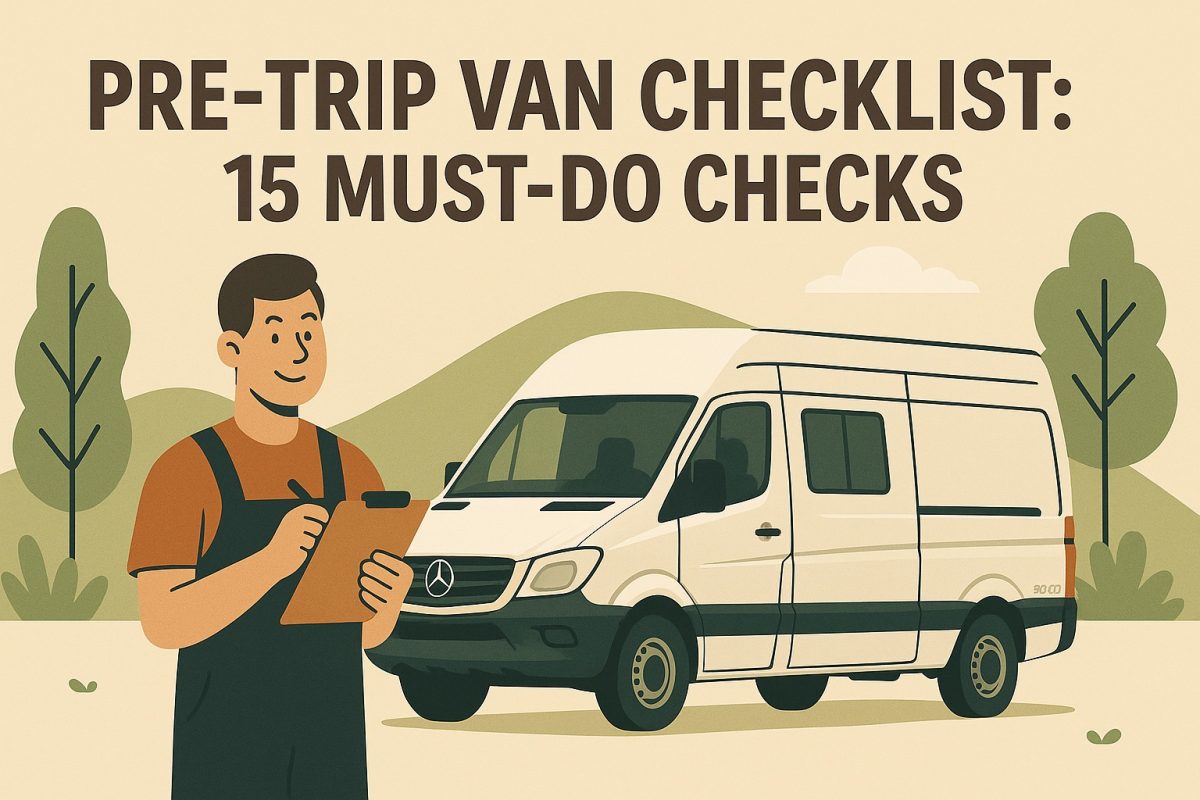
PRE-TRIP VAN CHECKLIST: 15 MUST-DO CHECKS

You know the drill: the alarm blares at silly-o’clock, coffee’s brewing, and you’re itching to point the van’s nose towards Cornwall. Then—click-click-click—your leisure battery mutters nah, pal. We’ve all been there, spanner in hand, wishing we’d spent ten minutes checking things the night before. 

To save you from dawn-of-departure drama, I’ve pulled together a no-nonsense, slightly cheeky road-trip safety check that covers everything from fan belts to fairy lights. Follow this guide and you’ll roll out of the drive confident your rig can handle whatever the UK’s roads (and weather) throw at it.

UNDER THE BONNET

FLUIDS & FILTERS

  • Engine oil – Check the dipstick when cold; top up if it’s below halfway. Dirty oil? Plan a change.
  • Coolant – Level between MIN and MAX; pink or orange sludge means it needs a flush.
  • Brake & clutch fluid – Low levels hint at worn pads or a leak.
  • Power steering / ATF – A quick top-up can stop embarrassing squeals at the campsite gate.
  • Screen wash – Cheap to fill, priceless when an HGV paints your windscreen in grime.

BELTS, HOSES & LEAKS

Give every rubber hose a squeeze—cracks or a marshmallow feel mean replacement. Spin the auxiliary belt; glazing or fraying is a red flag.

BATTERY (STARTER)

Clean terminals, snug clamps, and a voltage check with a multimeter (12.6 V+ at rest) keep gremlins at bay.

Van maintenance tip: carry a spare 10 mm spanner—90 % of battery clamps use one.

TYRES & WHEELS

  • Tread depth – UK legal minimum is 1.6 mm, but aim for 3 mm for proper wet-road grip.
  • Pressures – Cold-check against the door-pillar sticker; adjust for heavy loads.
  • Sidewalls – Bulges or cracks? Swap them before they pop on the M6.
  • Wheel nuts – Torque (tightening force in Newton-metres) to spec—usually 120 Nm on a T5.
  • Spare, jack & locking-nut key – Stow them where you can reach without emptying half the van.

LIGHTS, ELECTRICS & VISION

EXTERIOR

  • Headlights (dipped & main), indicators, brake lights, reverse, fogs. Replace blown bulbs now—saves the “polite” chat with traffic police.
  • Number-plate illumination—easy to forget, but an MOT fail.

INTERIOR & HAB

  • Leisure battery – Fully charged and holding 12.4 V+ after an hour off hook-up.
  • 12 V sockets & USBs – Test with a cheap phone charger.
  • Control-panel fuses—carry spares.

WIPERS & SCREEN

  • Blade rubber should flex, not smear. A fresh pair costs less than a pub lunch.
  • Top up winter-rated washer fluid even in summer—it has a higher detergent content.

INSIDE THE HAB AREA

GAS & APPLIANCES

  • Regulator & hoses – Check the expiry date. Hairline cracks? Replace.
  • Leak test – Soapy-water (a dab of washing-up liquid) round joints; bubbles = problem.
  • Fire up cooker, heater, and fridge for five minutes; better they quit on the drive than in Snowdonia.

WATER & PLUMBING

  • Fill the fresh tank; run each tap to purge air.
  • Inspect grey-water outlet for splits—nobody loves a stinky drip.

COMFORT & STORAGE

  • Secure drawers with latches; a rogue frying pan becomes a missile.
  • Bedding dry and mould-free? Give it a sniff—you’ll thank me later.

SAFETY ESSENTIALS & LEGAL BITS

  • MOT certificate & insurance – In date? Keep digital copies too.
  • Breakdown cover – Europe add-on if you’re crossing the Channel.
  • First-aid kit – Replace out-of-date dressings.
  • Warning triangle & hi-vis – French law still loves them.
  • Fire extinguisher & CO alarm – Test buttons weekly; replace batteries yearly.
  • Spare bulbs & fuses – Cheap insurance.
  • Driving licence & V5C – Glovebox heroes.

(DOT rating—Department of Transportation code—on tyres shows week/year of manufacture; over six years old? Consider new boots.)

FINAL PRE-FLIGHT WALK-ROUND

  • Doors & windows – Latch securely; check seals for leaks.
  • Roof – Solar panels, vents, awning rails: tight and rattle-free.
  • Bike rack / towbar – Bolts to spec, lights wired, and number plate visible.
  • Load height – Know it! Car-park barriers love fresh paint jobs.
  • Loose gear – Chairs, BBQ, toilet chemicals: bungee or box them.

QUICK REFERENCE CHECKLIST

  • Engine oil, coolant, brake fluid, PAS/ATF, screen wash
  • Belts, hoses, visible leaks
  • Starter battery voltage & terminals
  • Tyre tread, pressure, sidewalls, wheel-nut torque
  • All exterior lights & number-plate lamp
  • Wipers, washer fluid, windscreen chips
  • Leisure battery charge & 12 V sockets
  • Gas hoses, regulator, leak test
  • Cooker / heater / fridge test run
  • Fresh & grey-water system check
  • Fire extinguisher, CO alarm, first-aid kit
  • MOT, insurance, breakdown cover, licence, V5C
  • Spare bulbs, fuses, warning triangle, hi-vis
  • Roof fixtures, bike rack, load height noted
  • Doors, windows, interior cargo secured

(Screenshot or print this for glovebox glory.)

CONCLUSION

pre-trip inspection isn’t just ticking boxes—it’s buying peace of mind and guarding the holiday fund from surprise recovery bills. Spend half an hour on this checklist and you’ll cruise past lay-bys stuffed with steam-spewing vans, smug grin intact. Got a ritual I’ve missed? Drop it in the comments or tag me on Instagram @AVanLifeThing—photos of your toolbox welcome!

Episode 16 – The One with the Heart Attack

You wake up buzzing. Sun’s out. No aches. Today’s the day you finally crack on with the floor. You nip to Homebase for cheap brushes… except it’s shut for good. Fine. Wicks it is—warehouse vibes and DeWalt dads everywhere. You emerge with “Clean Spirits,” which turns out to clean absolutely nothing, plus a pack of brushes that should’ve stayed on the shelf. Still, morale high. Bacon roll (brown sauce, obviously). Then—somewhere between the car park and the A-road—that energy just drops through the floor. Like someone’s nicked your battery while you were paying for parking.

Read more

Instagram’s New Map: A Privacy Warning for Vanlife

TL;DR (read this if you skim everything)

Instagram has a new “Maps” feature that can pin your posts to an exact road. Quiet rollout. Big risk.

Van lifers, solo travellers, and families: this can expose your home, workshop, or park-up in real time.

Do this now:
1) Set Instagram Maps/location sharing to “No one.” Re-check often.
2) On your phone, deny location access for Instagram (and Facebook).
3) Don’t post from home or camp spots until after you’ve left. Avoid exterior clues.

Read more

100 Days to Van Life: Rust, Holes and Questionable Decisions

You know those days when you think, right, I’m finally getting my act together — and then your camera decides to record everything except the audio? Yeah, that’s been the general theme of my van build lately.

Progress has been slower than a pensioner overtaking on a hill, partly because I’ve been wiped out by some mysterious bug, partly because every job I start turns into a saga. But I’m stubborn, and apparently delusional enough to believe I can turn a 2016 Mercedes Sprinter into a home before July.

Read more

How to Sound Deadening Your Van Without Wasting Money

Driving for hours in a van is knackering enough without the constant deluge of road noise battering your ears. Every mile feels longer when you’re fighting tyre roar, wind noise, and the general racket of being inside a metal box doing 70mph.

Then you finally park up. Maybe it’s somewhere decent like the Lakes, thinking you’ll get a bit of birdsong and tranquillity. But the wind kicks off and the rain starts hammering the roof like a techno set at 3am. Or worse—you’re stuck in a layby next to the A1 trying to get some kip while every HGV thundering past sounds like it’s about to plough through your pillow.

Welcome to van life—where every inch of bare metal turns into a resonating chamber of chaos.

Sound deadening is one of those jobs everyone bangs on about during their build, and for good reason. Done properly, it transforms your van from a mobile drum kit into something you can actually sleep in. The trick is knowing what actually works and what’s just expensive marketing fluff.

Let’s strip back the hype and get into what’s actually worth doing to stop your van sounding like a biscuit tin in a blender.

Read more

5 Van Life Habits That Make Everyday Life Easier (and Keep You From Losing Your Mind)

When most people think of van life, they imagine waking up to stunning mountain views, sipping a hot brew with the back doors wide open. And sure, sometimes it’s like that. But most of the time? You’re brushing your teeth with half a bottle of water while trying not to knock over your portable toilet.

It’s a lifestyle that teaches you quickly: small habits make a massive difference. Here are five van life habits I’ve picked up that genuinely make day-to-day living smoother—and might just save your sanity on the road.

Read more

What I Wish I Knew Before Starting Van Life.

In this blog post I’ll share common beginner misconceptions and simple lessons about what I’ve learned starting out in Van life at a the age of 48 including expectations vs. reality, managing daily routines, plus unexpected benefits and challenges.

When I first started van life, one of the biggest challenges was finding safe, legal, and quiet places to park up for the night. I relied heavily on just one app Park4Night.—until I realised there were plenty of options and other smart techniques to make overnight stays a breeze. Here’s what I wish I’d known:

Read more