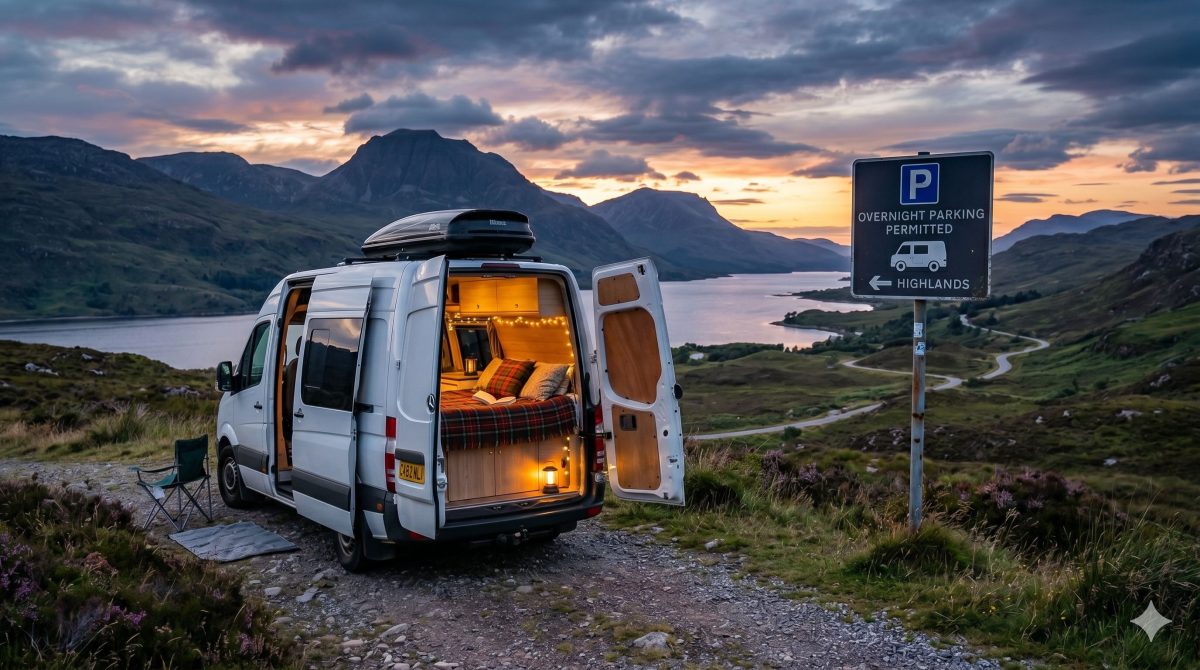
Short answer: mostly yes. Long answer: it’s complicated, and getting it wrong could cost you £25,000, three months in prison, and your driving license. Here’s what you actually need to know.
When I first moved into my Sprinter, I had a lot of questions. Where can I legally park? Am I allowed to sleep in my van? What if a police officer wakes me up? And most importantly, will I go to prison for having a nap?
I finally found someone who could actually answer these questions properly: a barrister named BlackBeltBarrister who recently made a video breaking down the legal side of sleeping in vehicles in England and Wales. After watching it, I realised I’d been doing some things right by accident, and there are definitely some traps I want to avoid.
Let me walk you through what I learned, because this applies to everyone living in a van, motorhome, or camper in the UK.
The Good News: There’s No Blanket Law Against It
Right, first the bit that makes you actually want to sleep in your van: there is no general law in England and Wales that automatically makes it illegal to sleep in your car or camper van.
If you’re tired, sober, you’ve parked somewhere lawfully, you’re not causing an obstruction, and you’re not trespassing — you’re generally fine. The Highway Code actually recognises that tiredness is dangerous, and explicitly says if you feel sleepy while driving, you should stop in a safe place.
Rule 91 is pretty clear: “If you feel sleepy, you should stop in a safe place, but not on the hard shoulder or in an emergency area on the motorway.”
So if you’re exhausted on a long journey and need a kip, the law isn’t against you. In fact, it’s encouraging you to do exactly that instead of driving half-asleep and potentially killing yourself or someone else.
The Legal Sweet Spot
Tired + Sober + Lawfully parked + Not trespassing + Not blocking anything = generally legal
The Bad News: The “In Charge” Trap
Right, this is where it gets properly complicated and where most people get caught out.
You can be prosecuted for “being in charge of a vehicle whilst over the alcohol limit” — even if you’re asleep, even if you’re in the back seat, even if the keys are in the glove box or the boot. The offense isn’t driving. It’s being in charge.
Here’s the scenario: You’ve been out for drinks. You realise you can’t drive home. Sensible decision, right? So you think, “I’ll just sleep it off in my van.” Wrong move, legally speaking.
If you’re over the prescribed limit and have access to the keys, you can be charged with being “in charge of a motor vehicle whilst unfit through drink or drugs.” This applies even if the engine isn’t running.
The penalties are not trivial:
- Up to 3 months in prison
- A fine of up to £25,000
- A driving ban (likely)
And here’s the thing that really gets people: even if you put the keys in the glove box, even if you had no intention of driving, the court will look at whether there was any likelihood you might drive whilst still over the limit.
It’s not about your intentions. It’s about likelihood.
The Statutory Defence
There IS a legal defence available. Under Section 52 of the Road Traffic Act 1988, you can argue that there was absolutely no likelihood of you driving while over the limit.
What Actually Matters to the Court?
If you got pulled over and charged with being in charge whilst over the limit, a court would look at all of the circumstances. Here’s what they’d consider:
The Court’s Checklist
- Where were you parked?
- Were you in the driver’s seat or back seat?
- Where were the keys?
- Was the engine warm? Had it been recently driven?
- Were you parked outside a pub?
- Did you have a hotel booked nearby?
- Did you have arrangements for someone to collect you?
- Did you pay for an overnight stay (which shows intent)?
- How long had you been there? 30 minutes or 8 hours?
If you’re at a motorway car park where you’ve paid for overnight parking, the blinds are drawn, the bed is made up, you’re clearly set for the night — that’s a very different situation from being parked outside a pub with the keys in the ignition after three pints.
The problem is, the police officer at the roadside won’t wait for a full trial. They’ll make a judgment call in the moment. If they find you absolutely hammered with access to the keys, they might arrest you on the spot.
“Don’t use your van as a backup bedroom after you’ve been out drinking. Use a hotel, taxi, friend’s sofa, or leave your van there and collect it the next day.”
— BlackBeltBarrister
What About Camper Vans Specifically?
Here’s what a lot of van lifers get wrong: A camper van is still legally a vehicle. The fact that it has a bed, a kitchen, and a chemical toilet doesn’t exempt it from road traffic laws.
The same rules apply. You can be drunk in charge of a camper van just like you can a car.
However — and this is important — you have a stronger legal argument in some situations. If you’re obviously pitched up for the night (blinds down, bed made, plugged into electricity at a campsite), you’re in a much better position than someone sleeping it off on the roadside.
Again, it comes down to circumstances and likelihood. If you can clearly demonstrate that you weren’t going anywhere and there was no risk of you driving that vehicle, you’re in a stronger position.
The Private Land Problem
Whether it’s a car park, a quiet layby, a field, or a roadside, you need to know one thing: is it private land, and do you have permission to be there?
Car parks are usually private land. If you’re parking there overnight and there’s no sign saying you can’t, you’re probably okay — but some car parks specifically prohibit overnight parking. Check before you settle in.
If you find a field and decide to park in it, that’s almost certainly private land belonging to a farmer or landowner. You’re trespassing. Don’t do this without permission.
Since the Police Crime Sentencing and Courts Act of 2022, there are specific criminal offences relating to residing on land without consent in a vehicle. This was designed to target intentional unauthorised camping, but the point is: permission matters.
The easiest way to get permission is to pay for it (campsite, pub car park, motorway services). The next easiest is to ask the landowner in advance.
Where You Can (Usually) Sleep
Motorway Services
Most allow parking for 2-3 hours free, some allow overnight stays in designated areas. Check the specific services. If you fall asleep and overstay, you might get a parking charge notice — but honestly, that’s better than crashing at 70 mph.
Campsites & Farm Stays
If you’ve paid or have explicit permission, you’re fine. Websites like Pitchup.com list farms, pubs, and fields that allow campers to stay overnight.
Pub Car Parks
Some pubs allow overnight parking (especially farmhouse pubs in tourist areas). Ask the landlord.
Paid Car Parks
If overnight parking is allowed and you pay for it, you’ve got permission and you’re covered.
Side Roads & Laybys
Check for no-parking restrictions, especially in holiday destinations like Cornwall. Many now prohibit overnight van parking. Look for signs.
Random Field/Roadside
Don’t do this without permission unless you’re absolutely certain it’s not private land. New laws make this risky.
The Practical Bit: How Not to Wreck Your Life
Look, the legal side is one thing. But getting prosecuted for drunk in charge has massive knock-on consequences that go way beyond the immediate fine or ban.
If you drive for work (or if your employer requires a clean licence), you could lose your job. Lose your job, lose your money. Can’t pay the mortgage or rent. Relationship falls apart. All of that can spiral from one night sleeping it off in your van after a few drinks.
So here’s the practical guidance:
Don’t Risk It
- If you’ve been drinking, don’t use your van as a backup bedroom.
- Use a taxi, book a hotel, call a friend, sleep on someone’s sofa, leave your van and collect it tomorrow.
- If you’re on a proper campsite or have paid for overnight parking, the rules are different — you’ve got permission and a clear intent to stay.
- If you’re sober and just tired from driving, sleeping in your van is the right thing to do.
The Bottom Line
Is it legal to sleep in your van? Generally, yes. If you’re tired and sober, parked somewhere you’re allowed to be, not blocking anything, and not trespassing.
But there are enough traps and circumstances where it becomes complicated — especially involving alcohol, private land, and overnight parking restrictions — that you need to think about it before you park up.
The safest approach is:
- Know where you are. Is it private land? Is overnight parking allowed? Do you have permission?
- Don’t drink and sleep in your van. The law on “in charge” is strict and the penalties are serious.
- If you’re tired from driving, sleep. That’s literally what you should do. Tiredness kills.
- Pay for legitimate parking when you can. Campsites, services, pub car parks. It shows intent and covers you.
I’ve been van living since December 2024, and I’ve been fortunate enough to avoid any drama with the law. Partly that’s luck, but mostly it’s because I try to be sensible about where I park and I definitely don’t sleep in my van after drinking.
Do that, and you should be fine.
